
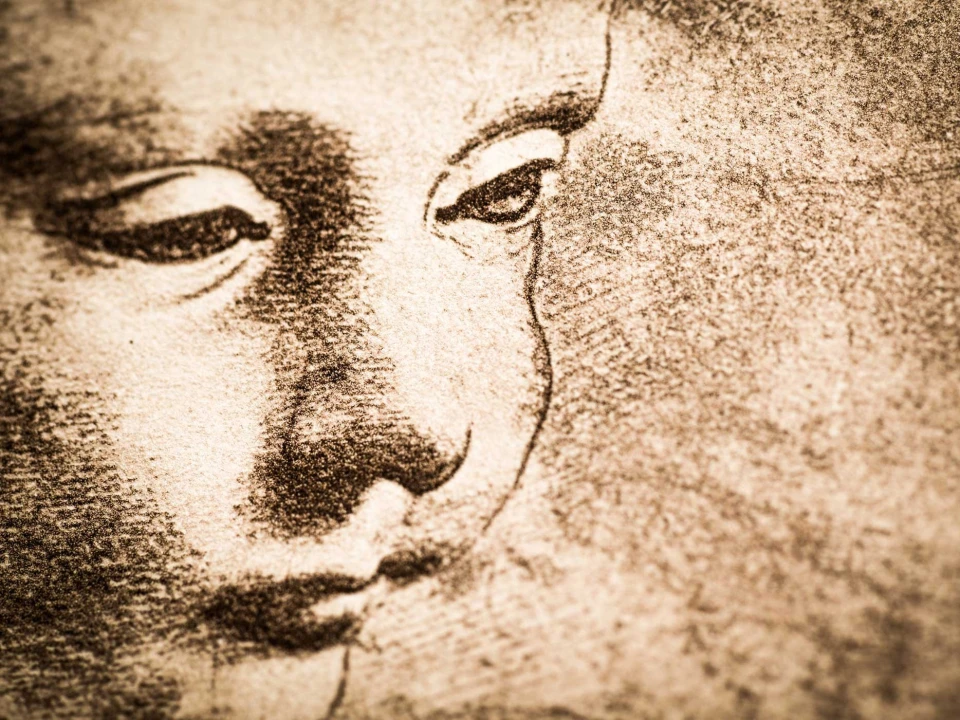
Researchers may be closer than ever to identifying biological traces linked to Leonardo da Vinci, thanks to new scientific analysis applied to a small red-chalk drawing traditionally known as Santo Bambino.
The work, a delicate study of a young child’s head, has long been debated by art historians, with questions surrounding both its attribution and its place within Leonardo’s broader body of work.
Using highly controlled, non-invasive techniques, scientists gently collected microscopic residues from the surface of the paper. The goal was to recover any surviving biological material without damaging an artwork that is more than 500 years old. The results revealed extremely small fragments of DNA, including traces associated with the male Y chromosome. While the amount of genetic material was minimal, it was enough to allow preliminary classification into a broad genetic group still found today in parts of southern Europe and the Mediterranean.
These findings do not provide definitive proof that the DNA belongs to Leonardo da Vinci himself. Over centuries, drawings like this one were touched, stored, transported, and restored, making contamination unavoidable. Even a single handling event in the 19th or 20th century could have left biological traces that persist today. Complicating matters further, Leonardo left no known direct descendants, and the precise location of his remains was lost centuries ago, eliminating the possibility of direct genetic comparison.
Despite these limits, the discovery is considered significant. It demonstrates that paper artworks from the Renaissance can still preserve molecular information after half a millennium. Researchers believe that by examining a larger group of drawings and manuscripts firmly attributed to Leonardo, it may be possible to isolate recurring genetic markers and distinguish them from later contamination.
Beyond questions of authorship, this line of research opens new possibilities for art history. Scientific data could one day support or challenge traditional stylistic analysis, helping scholars resolve attribution debates that have lasted for decades. While DNA alone will never replace historical and visual study, it may soon become a powerful complementary tool in understanding one of history’s most studied figures.