
A new trade move in the Western Hemisphere is reshaping the competitive landscape for some of Italy’s most iconic food products. Under a recently finalized bilateral agreement between the United States and Argentina, dozens of traditional European food names are now officially treated as generic in the Argentine market.
That decision opens the door for locally produced goods to use labels long associated with specific regions of Italy, weakening the commercial power of authentic products protected under European law.
The agreement lists 39 food names considered generic. Among them are Parmigiano Reggiano, Grana Padano, Gorgonzola, Asiago, and Mascarpone. Several cured meats are also included, such as Prosciutto, Pancetta, Capocollo, and Salame. Within the European Union, many of these products carry Protected Designation of Origin status, meaning they must be made in defined geographic areas according to strict production standards. Outside that system, however, producers are increasingly free to replicate the names without following the original rules.
Take Parmigiano Reggiano as an example. Authentic wheels are produced only in specific provinces of Emilia-Romagna and Lombardy, using local milk and a minimum aging period of 12 months, often extending to 24 or even 36 months. Annual production exceeds 4 million wheels, generating billions of euros in export value. Grana Padano follows similarly rigorous standards, with yearly output surpassing 5 million wheels. Together, these cheeses represent a substantial share of Italy’s agri-food exports, which total more than €60 billion per year.
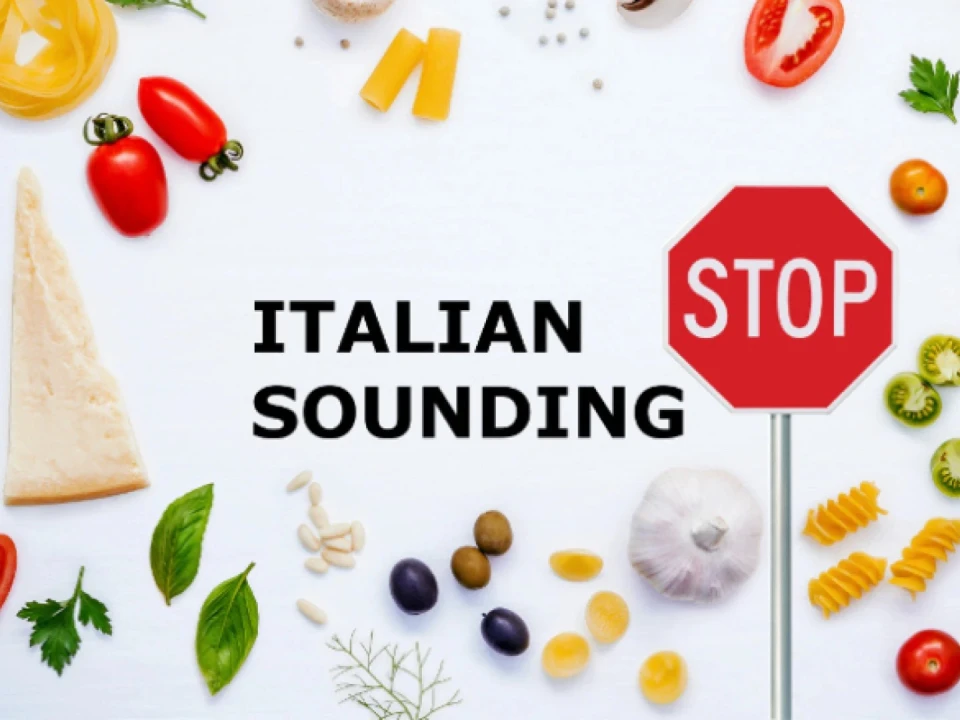
When the same names are used generically, the distinction between authentic and imitation products becomes blurred. In the United States alone, production of cheese labeled “Parmesan” is estimated to exceed 150,000 metric tons annually – far more than the volume of genuine Parmigiano Reggiano imported from Italy. Studies indicate that roughly 90% of cheeses sold under Italian-sounding names in North America are domestically produced copies rather than original PDO goods. The price difference can be significant: imitation Parmesan may retail for 30%–50% less than the authentic Italian version.
This price gap creates a structural disadvantage for Italian producers. PDO products carry higher costs due to strict raw-material standards, longer aging times, and regulatory compliance. When foreign markets legally classify these names as generic, consumers may assume all similarly labeled products are equivalent. That confusion erodes brand value built over centuries and reduces the premium that authentic producers depend on.
The impact extends beyond cheese. Prosciutto di Parma and Prosciutto di San Daniele, for instance, require precise curing periods and controlled regional production. If “prosciutto” is widely treated as a generic term without geographic distinction, lower-cost imitations can compete directly while avoiding the expenses tied to Italian origin rules. The same risk applies to Gorgonzola and Asiago, whose identities are closely linked to specific territories and traditional methods.
For Italy’s rural economies, this issue is not symbolic – it is financial. Thousands of farms and small dairies depend on export markets. If imitation products gain even 5%–10% additional market share in key countries, the revenue loss could amount to hundreds of millions of euros annually. Over time, that pressure may reduce investment in traditional production and weaken the economic sustainability of entire districts.
Authentic Italian food products derive their value from traceability, geography, and craftsmanship. When international agreements dilute the protection of their names, the competitive balance shifts toward mass-produced alternatives. The result is a marketplace where “Parmesan” may outsell Parmigiano Reggiano, not because of quality, but because of regulatory redefinition.