
My family has its roots in Pievepelago, high in the Tuscan-Emilian Apennines, and perhaps that is why the history of emigration from these mountains to the United States has always felt personal to me. Many people left precisely from Pievepelago and neighboring communities, carrying with them their traditions, their dialect, their ability to work hard and, above all, the hope of building a better future in America.
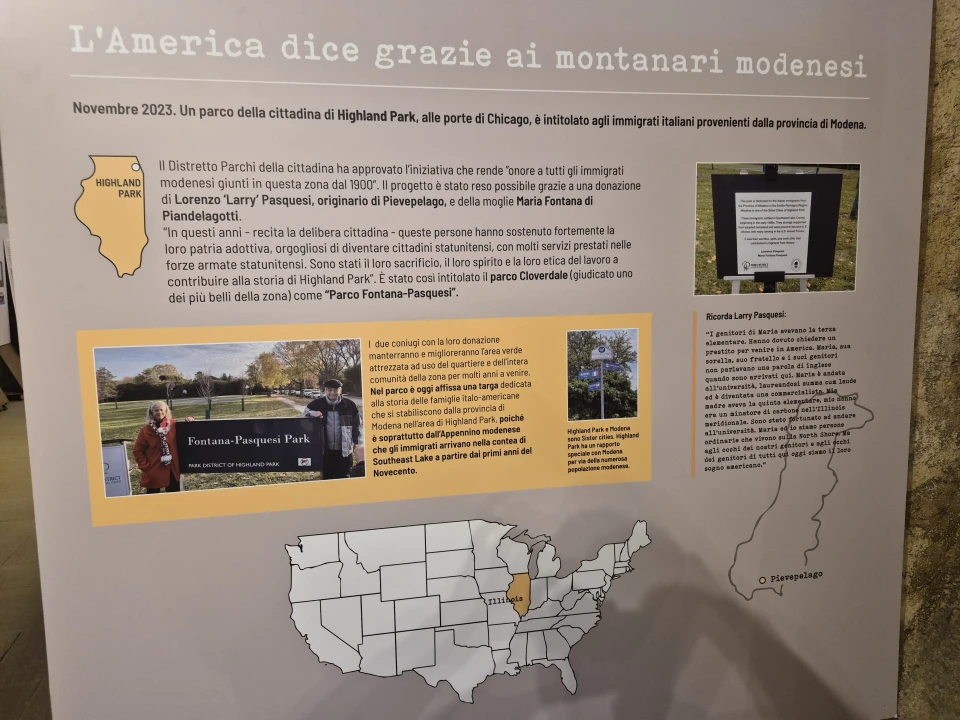
This extraordinary story is now being told in Fanano through the exhibition “La salvaguardia delle diversità culturali. L’emigrazione dall’Appennino modenese negli Stati Uniti,” hosted in the Sala degli Scolopi from August 1 through October 19, 2026.
Organized by the Department of Law of the University of Modena and Reggio Emilia and the Accademia del Frignano “Lo Scoltenna,” in collaboration with the Municipality of Fanano, the exhibition uses documents, photographs and personal stories to reconstruct the migration from our mountains between the second half of the 19th century and the postwar years.
The numbers reveal the scale of this phenomenon. In 1921, the Fanano area alone recorded 1,340 emigrants out of a population of approximately 6,000. Pievepelago, Fiumalbo, Sant’Annapelago, Fanano and other communities across the Frignano became departure points for journeys that would reshape families on both sides of the Atlantic. Illinois became one of the most important destinations. The towns of Highwood and Highland Park, north of Chicago along Lake Michigan, developed remarkable enclaves of families originating in the Modena Apennines.
Today, more than 5,000 people of Modenese origin and their descendants are estimated to live in the Highwood–Highland Park area. There were also dramatic chapters. On November 13, 1909, the Cherry Mine disaster in Illinois killed 259 miners. More than 50 victims came from the Modena Apennines, including 11 men from Fanano. But there were extraordinary individual stories too.
Felice Pedroni, born in Trignano di Fanano in 1858 and known in America as Felix Pedro, discovered gold near present-day Fairbanks in 1902, helping spark the Fairbanks Gold Rush. Primo Bartolini left Fanano for Tennessee in 1907 and became an important figure in Nashville’s cultural and educational life.
For me, this is why the exhibition in Fanano is much more than a historical exhibition. It tells a story that still lives among us. From Pievepelago and Fanano to Highwood, Highland Park, Nashville and Alaska, our Apennines became part of America – while generations of Americans never completely stopped belonging to these mountains.