
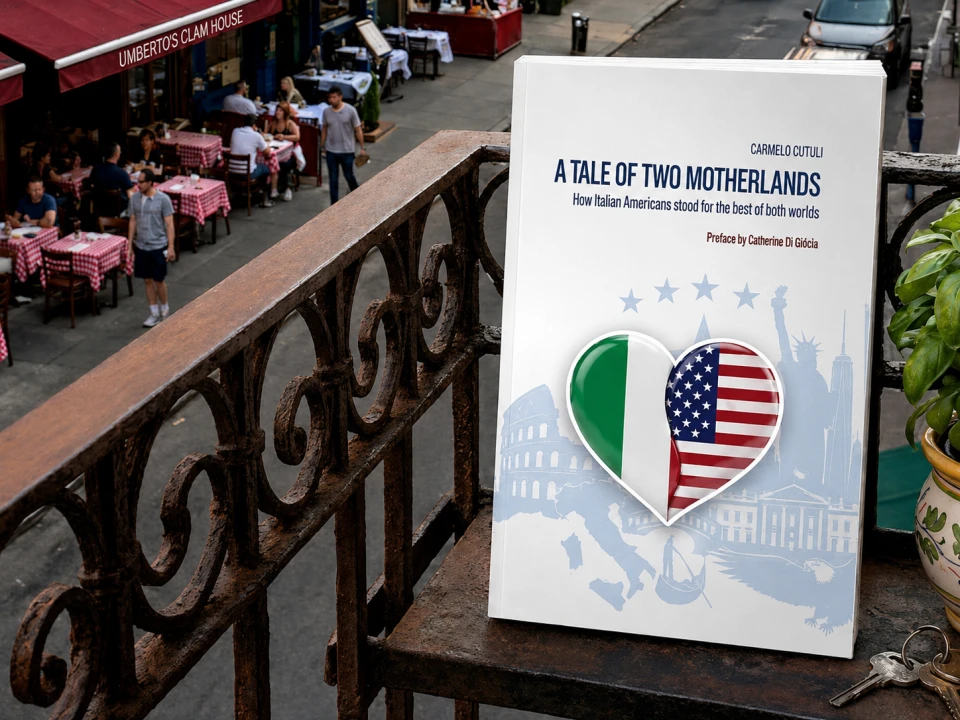
In A tale of two motherlands, Carmelo Cutuli presents a thoughtful sociological examination of the Italian diaspora in the United States. The book, introduced by a preface from Caterina Di Chiara, Secretary of Associazione Joe Petrosino Sicilia, opens with the framework of "bidirectional cultural transformation."
The core thesis is both straightforward and compelling: Italian Americans did not merely integrate into an existing American identity — they contributed enormously to giving it shape. The author structures his argument across several distinct cultural domains, remembering how Italian practices migrated from ethnic enclaves to the American mainstream, enriching the nation's collective identity in the process.
One of the book's most engaging domains of analysis concerns food. The author adds to the understanding of Anglo-American food culture the Italian emphasis on convivialità — the art of living and eating together. He explains how traditions such as the "Sunday Sauce" transformed the act of eating from a matter of individual convenience into a communal ritual that fostered deep social bonds. In doing so, he positions food not merely as sustenance but as a vehicle for community building, intergenerational connection, and cultural continuity. This reframing invites readers to consider how immigrant foodways have contributed a more relational, human-centered dimension to American dining culture.
From the domestic table, the author moves outward to the street. Italian immigrants, he argues, brought what he terms the "Piazza Principle" to America — adapting Mediterranean customs of outdoor social interaction to urban landscapes that had often prioritized private, enclosed domestic life. Activities such as the passeggiata (the evening stroll) and vibrant street festivals transformed public areas into informal living spaces, fostering neighborliness and collective belonging. This section offers a valuable perspective on how immigrant communities have contributed to more inclusive and socially dynamic conceptions of public space in American cities.
This transformation of shared spaces naturally extends into the realm of emotional expression and the arts. The book explores how Italian Americans have profoundly characterized the American cultural scene across multiple domains. In music, the bel canto tradition influenced American vocal techniques and emotional delivery, with performers such as Frank Sinatra and Tony Bennett helping to broaden the boundaries of American masculinity by embracing emotional vulnerability and openness on stage. Rather than conforming to prevailing cultural expectations of restraint, these artists offered an alternative model of strength rooted in expressiveness. But the Italian American imprint reaches far beyond music. In cinema, figures like Martin Scorsese, Francis Ford Coppola, and Frank Capra shaped the very language of American filmmaking, bringing narrative intensity, moral complexity, and a deep sense of place to the screen. In literature, in fashion, in design, Italian American sensibility introduced an aesthetic richness and an attention to craft that became inseparable from American popular culture itself. Taken together, these contributions expanded the emotional and artistic vocabulary available to all Americans regardless of background.
Underpinning all of these cultural contributions, the author identifies the family as the foundational structure. In his discussion of La Famiglia, he highlights the extended family model that prioritized collective responsibility and multigenerational bonds. He presents this tradition as a meaningful counter-model to the post-war American nuclear family, suggesting that Italian American family structures offered a blueprint for mutual support, resilience, and shared obligation. This analysis resonates particularly well in contemporary discussions about the importance of community networks and intergenerational solidarity.
Beyond these thematic explorations, one of the most insightful aspects of the work is its treatment of campanilismo — the intense regional loyalty to one's local bell tower. It is essential to consider that during the great emigration of the late nineteenth and early twentieth centuries, Italians did not arrive in America as "Italians" in any unified sense. Italian Unification was still remarkably young, and immigrants carried with them deeply rooted regional identities — so distinct in language, customs, and traditions that not only did those from the north differ profoundly from those from the south, but very often even those from neighboring regions were markedly different from one another. The author notes that the approximately four million immigrants who arrived between 1880 and 1924 largely identified as Neapolitans, Sicilians, or Calabrians. He effectively argues that the cohesive, pan-Italian identity recognized today was not an import from the old country but was actually forged through the shared American immigrant experience — a powerful reminder that identity is fluid, constructed, and shaped by collective struggle.
A Tale of two motherlands is ultimately a valuable resource for anyone interested in sociology, immigration history, and American studies. It provides an original point of view for understanding how modern American culture is not a static monolith but a continuous, reciprocal negotiation of identities. Carmelo Cutuli worked for years between Italy and the United States, developing an intimate knowledge of the Italian community in America. He has since brought this wealth of experience and relationships back to his home country, founding the Rome Chapter of the Order Sons and Daughters of Italy in America (OSDIA) — the first OSDIA lodge ever established outside the North American continent in over 100 years of the organization's history. This unique biographical trajectory lends the book an authenticity and depth of perspective that purely academic treatments of the subject often lack. In an era when conversations about immigration and cultural belonging remain as vital as ever, this work serves as a timely reminder that national identity is strongest when it embraces the contributions of all its communities — and that cultural exchange, at its best, is never a one-way street.