In 2026, We the Italians celebrates “Two Anniversaries, One Heart” – the 250th anniversary of the United States and the 80th anniversary of the Italian Republic. This article is part of the “Happy Birthday USA: Unsung Italian Heroes” project, in which we share how, in every corner of the United States, an Italian has made a positive impact on their local community.
---
Dominic Altieri, carving out a monumental role in a new world
For over 125 years the traditions of southern Italy have profoundly shaped the character of Westchester County’s architecture and landscape, most prominently witnessed in stucco building façades, public works of stone, and a wide spectrum of natural enhancements.
Consider the Hudson River town of Dobbs Ferry. In 1885 a mere six Italians resided there, while by 1920 the village population, which had more than doubled, was 60% southern Italian immigrants from the province of Avellino in Campania who had made the town their home. Many of the new arrivals settled on Main and Palisade Streets, where they re-created hilltop piazzas, gardens and stucco dwellings reminiscent of their former homeland. Houses made of clapboard were covered with stucco, stone retaining walls were constructed, fig trees were planted and backyard shrines erected.
An impressive reinterpretation of southern Italian vernacular architecture can be seen in the work of Dominic Altieri, a stonemason from the village of Bovino, who settled in Dobbs Ferry and infused the memories of his birthplace in the design and construction of his family’s home—the “house of his dreams,” according to his daughter, Val Coletti—on Main Street. It’s an inviting four-story dwelling with a distinctive façade of stonework porticos and porches; town residents referred to it as “the Palazzo.”
Shortly afterward, in 1923, Altieri would build a replica of the cathedral in the Avellino hilltop village of Calitri, using stone from area quarries. Our Lady of Pompeii Church still stands on Palisade Street, as does his “Palazzo” on Main, an enduring testament to the Altieri legacy.
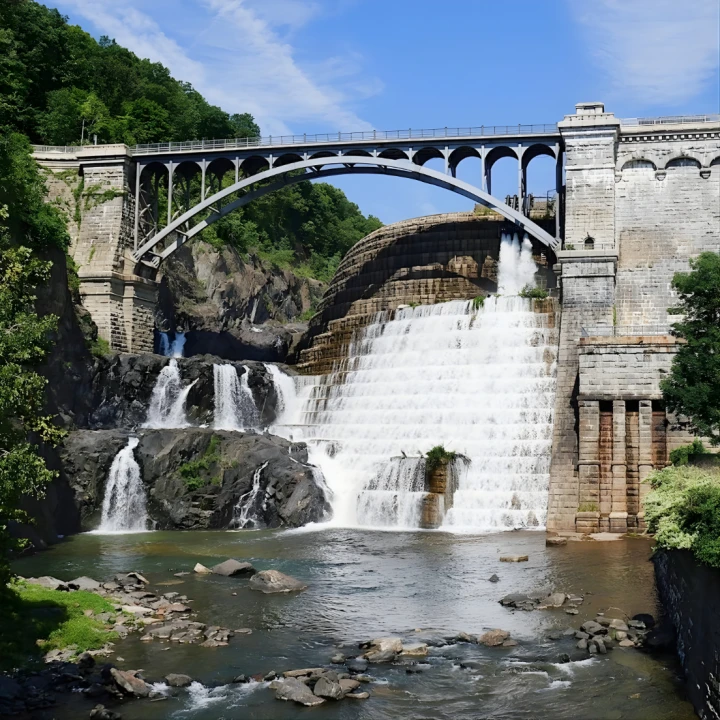
Less than 15 miles north of Dobbs Ferry one can hear the refreshing sounds of waterfalls and enjoy the magnificence of the New Croton Dam, an area landmark. Far more than an extraordinary feat of civil engineering inspired by Roman ingenuity, it’s a place layered with history and grandeur. Its story was largely shaped by the hands of Italian stonemasons who settled in the Hudson River towns of Dobbs Ferry, Ossining and Croton-on-Hudson (as well as neighborhoods in lower Manhattan and the Bronx).
Completed in 1906, the new dam and water transport system was designed to address the rapidly increasing demand for clean water in New York City. The dam stands 300 feet high; the 150-foot deep water system ran for 33-miles and required precise stone-cutting and placement to withstand the pressure of 19 billion gallons of water. Their construction took fourteen years of arduous and perilous labor. At the time of its completion, the dam was the tallest in the world!
Westchester’s New Croton Dam stands as not only a great feat of engineering but also a monument to the immigrant labor that made it possible. Although the over 2000 Italian masons who were the backbone of its construction were never formally credited, their work shaped the infrastructure that helped New York City thrive. Today, their legacy lives on not just in historical records but in the enduring and imposing presence of the dam itself. In 1978, the New Croton Dam was officially added to the National Register of Historic Places, a lasting tribute to the skill, sacrifice, and endurance of those who built it.
Nel 2026 We the Italians celebra Two Anniversaries One Heart, i 250 anni degli Stati Uniti e gli 80 anni della Reubblica Italiana. Questo articolo fa parte del progetto Happy Birthday USA: The Unsung Italian Heroes, in cui raccontiamo perchè in ogni angolo degli Stati Uniti qualcuno italiano ha lasciato un impatto positivo per il singolo territorio.
---
Dominic Altieri, che costruì un ruolo monumentale in un nuovo mondo
Per oltre 125 anni le tradizioni dell’Italia meridionale hanno profondamente plasmato il carattere dell’architettura e del paesaggio della contea di Westchester, visibile soprattutto nelle facciate in stucco degli edifici, nelle opere pubbliche in pietra e in una vasta gamma di interventi naturali.
Si consideri la cittadina sul fiume Hudson di Dobbs Ferry. Nel 1885 vi risiedevano appena sei italiani, mentre nel 1920 la popolazione del villaggio, più che raddoppiata, era composta per il 60% da immigrati dell’Italia meridionale provenienti dalla provincia di Avellino in Campania, che avevano fatto del luogo la loro casa. Molti dei nuovi arrivati si stabilirono lungo Main Street e Palisade Street, dove ricrearono piazze collinari, giardini e abitazioni in stucco che richiamavano la loro terra d’origine. Le case in legno vennero rivestite di stucco, furono costruiti muri di contenimento in pietra, piantati alberi di fico ed eretti piccoli santuari nei cortili.
Una straordinaria reinterpretazione dell’architettura vernacolare dell’Italia meridionale si può osservare nel lavoro di Dominic Altieri, scalpellino originario del paese di Bovino, che si stabilì a Dobbs Ferry e infuse i ricordi della sua terra natale nella progettazione e costruzione della casa di famiglia – la “casa dei suoi sogni”, secondo la figlia Val Coletti – su Main Street. Si tratta di un’accogliente abitazione di quattro piani con una caratteristica facciata composta da portici e logge in pietra; i residenti la chiamavano “il Palazzo”.
Poco dopo, nel 1923, Altieri costruì una replica della cattedrale del borgo collinare di Calitri, in provincia di Avellino, utilizzando pietra proveniente da cave locali. La chiesa di Nostra Signora di Pompei si trova ancora oggi su Palisade Street, così come il suo “Palazzo” su Main Street, testimoni duraturi dell’eredità degli Altieri.
A meno di 15 miglia a nord di Dobbs Ferry si possono ascoltare i suoni delle cascate e ammirare la maestosità della diga di New Croton, uno dei principali punti di riferimento della zona. Molto più di una straordinaria opera di ingegneria civile ispirata all’ingegno romano, è un luogo ricco di storia e imponenza. La sua realizzazione fu in gran parte modellata dalle mani degli scalpellini italiani che si stabilirono nelle città lungo l’Hudson come Dobbs Ferry, Ossining e Croton-on-Hudson, oltre che in quartieri di Lower Manhattan e del Bronx.
Completata nel 1906, la nuova diga e il sistema di trasporto dell’acqua furono progettati per rispondere alla crescente domanda di acqua pulita a New York. La diga raggiunge i 300 piedi di altezza; il sistema idrico, profondo 150 piedi, si estende per 33 miglia e richiese una lavorazione e posa della pietra estremamente precise per resistere alla pressione di 19 miliardi di galloni d’acqua. La costruzione richiese quattordici anni di lavoro duro e pericoloso. Al momento del completamento, la diga era la più alta del mondo.
Oggi l’imponente struttura in muratura è inclusa da Smithsonian Magazine tra le più grandi opere in pietra scolpita a mano al mondo, insieme alla Grande Piramide di Giza in Egitto, al complesso templare di Baalbek in Libano e a Borobudur in Indonesia.
La diga di New Croton a Westchester rappresenta non solo un grande risultato ingegneristico, ma anche un monumento al lavoro degli immigrati che la resero possibile. Sebbene oltre 2.000 scalpellini italiani, che costituirono la spina dorsale della sua costruzione, non siano mai stati ufficialmente riconosciuti, il loro lavoro ha contribuito a creare le infrastrutture che permisero a New York di prosperare. Oggi la loro eredità vive non solo nei documenti storici, ma anche nella presenza imponente e duratura della diga stessa. Nel 1978 la diga di New Croton è stata inserita nel National Register of Historic Places, un tributo permanente all’abilità, al sacrificio e alla resistenza di coloro che la costruirono.