
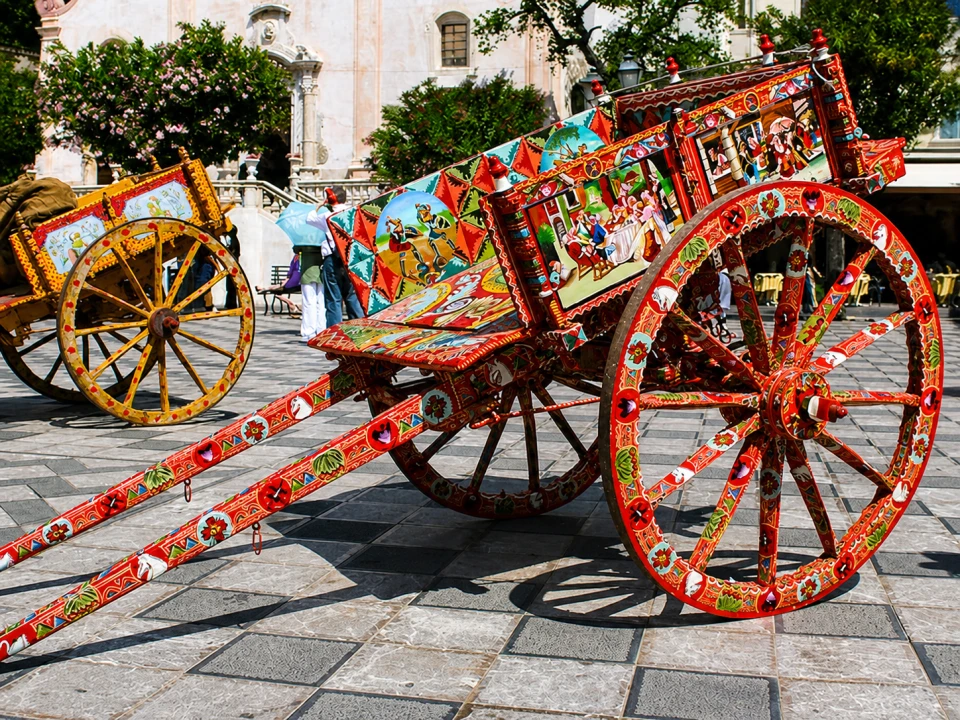

The art of Sicilian carts is a visual explosion that seems created to be seen before it is understood. More than an object, the cart is a moving narrative surface – a three-dimensional canvas where color becomes language and detail turns into emotion. Every inch is painted, carved, decorated – nothing is left neutral. It is a total form of art, combining painting, sculpture, and design into a single creative gesture.
What stands out immediately is color. Bright red, vivid yellow, deep blue, saturated green – there are no half tones. The contrasts are sharp, deliberately bold, almost theatrical. The cart does not aim for balance, but for impact. It is designed to be seen from a distance, to capture attention instantly. In this sense, it feels surprisingly modern, communicating with the same immediacy as pop art or contemporary murals.
The surfaces of the cart are completely covered with imagery. The wheels become decorated discs, often among the most striking elements, with spokes painted like rays of sunlight or geometric patterns that suggest motion even when still. The side panels are true pictorial scenes – dense compositions framed by ornamental borders, where every space is filled with almost obsessive precision. Even structural parts – beams, edges, corners – are carved or painted, turning the entire object into a distributed sculpture.
One fascinating aspect is repetition. Floral motifs, arabesques, scrolls, and decorative patterns chase one another, creating a continuous visual rhythm. This is an art form that does not rely on a single image, but on the overall effect. The eye never rests – it moves, jumps, returns. The experience is almost hypnotic. In this sense, the cart is not simply observed – it is visually navigated.
There is also a strong narrative component, but treated in a highly visual way. The painted scenes are not realistic – they are stylized, intense, and full of expression. Faces are sharply defined, gazes direct, gestures exaggerated. Everything is constructed to be immediately readable, almost like illustration or comic art. Figures seem to emerge from the background, often framed by even brighter colors, creating a simple but effective sense of depth.
Perhaps the most striking feature is the absence of empty space. Every surface is filled, every border decorated. This visual density creates a sense of abundance, of constant energy. It is the opposite of minimalism – here, value lies in layering, complexity, and controlled excess. Yet despite the richness of elements, the overall composition remains coherent. There is an internal logic, a precise visual grammar that holds everything together.
Wood itself plays a fundamental role. It is not just a support, but an active part of the artwork. Carvings add depth, creating shifts of light and shadow that change throughout the day. When light hits the carved surfaces, the cart seems almost to come alive, as if the decorations were subtly moving. It is an art form that lives through light as much as through color.
Another interesting aspect is the strong stylistic identity. Every cart is different, yet recognizable. There are distinct hands, styles, visual signatures, even without explicit attribution. You can sense a personal language, a variation within a shared aesthetic system. This makes each piece unique while still belonging to a common visual tradition.
Today, this art form has moved beyond its original context and entered the world of design and contemporary art. The motifs of Sicilian carts are reinterpreted in objects, textiles, and installations, retaining their visual power. This is not nostalgia, but transformation – an aesthetic that continues to resonate because it is immediate, bold, and unmistakable.
The Sicilian cart is not just decoration. It is a visual statement, an exercise in aesthetic intensity. It is color without hesitation, form without pause, detail without compromise. To look at it is to enter a continuous flow of images, where art is not simply observed – it is experienced.