
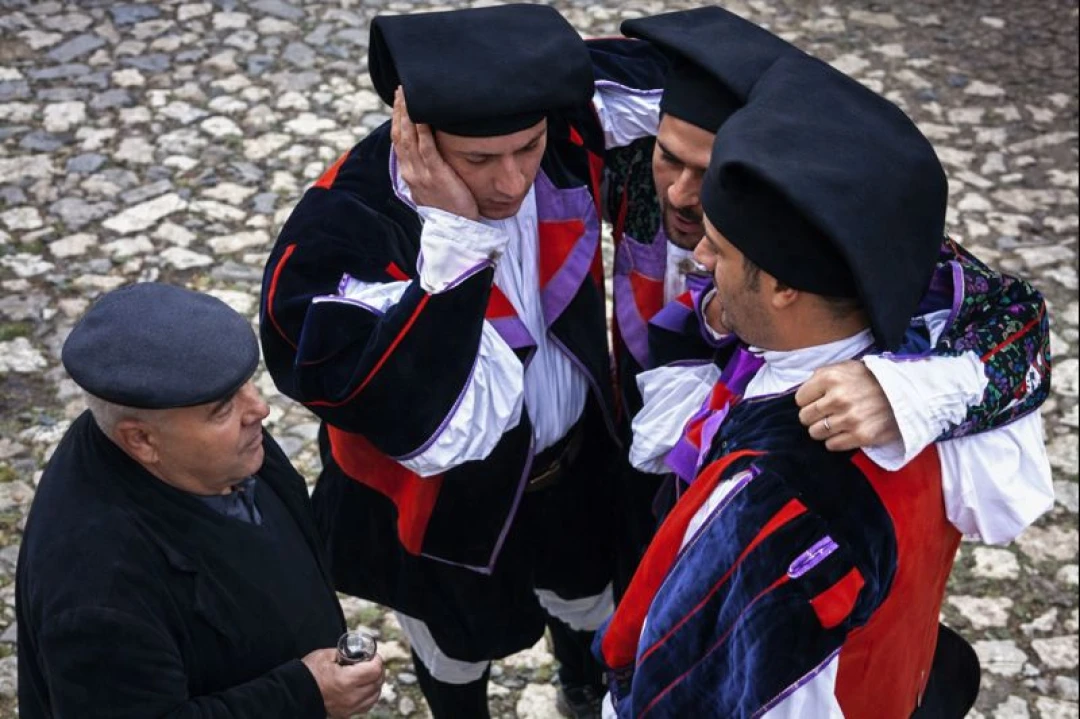

Four men sing, yet listeners clearly perceive five distinct voices. It sounds like a paradox, but this acoustic illusion has been part of daily life for centuries in the interior of Sardinia. It takes shape through Canto a Tenore, an ancient vocal tradition formally recognized by UNESCO as part of the world’s intangible cultural heritage.
A traditional Tenore group consists of four male singers standing close together in a circle. Each voice has a specific name and function. Sa boche is the leading voice, carrying the melody and the lyrics with a clear, flexible tone. Sa bassu provides the foundation, producing extremely low, guttural sounds that can fall below 100 hertz and give the music its earthy power. Sa contra and sa mesu boche complete the structure, inserting sharp, vibrating harmonics that sit between melody and bass. Individually, the voices sound unusual. Together, they create something entirely new.
When the singers achieve perfect balance, something remarkable happens. The interaction of vocal frequencies generates overtones that the human ear perceives as an additional sound. This acoustic byproduct, often occurring in the 2,000–3,000 hertz range, feels like a fifth voice floating above the group. No one is singing it, yet everyone hears it. The effect is so vivid that many first-time listeners instinctively look for a hidden performer.
This phenomenon is not mystical. It is the result of precise control over breath, pitch, and resonance, refined over hundreds of years without any formal knowledge of acoustics. In the mountainous region of Barbagia, communities developed these techniques through observation and repetition. Shepherds learned how different intervals interacted in open landscapes, discovering through experience what modern physics later explained with wave theory.
Canto a Tenore was never designed for concert halls. It belonged to everyday life. Songs accompanied agricultural work, religious festivals, and long evenings spent together. Performances could last anywhere from a few minutes to more than ten, slowly evolving as the singers adjusted rhythm, intensity, and vocal color. The repertoire includes hundreds of songs, passed down orally, with each village preserving subtle variations.
Today, fewer than 300 active Tenore groups are estimated to exist, and mastering the style still requires years of training. Younger singers must learn how to strain the vocal cords safely while maintaining the rough textures that define sa bassu and sa contra. Despite its ancient roots, the tradition continues to attract international audiences, many of whom are astonished by the sheer physicality of the sound.
Canto a Tenore shows how the human voice, used collectively, can create complex sonic structures without instruments or technology. When ancestral knowledge and natural acoustics intersect, the result is a powerful reminder that some of humanity’s most striking achievements are born from shared breath, listening, and time.