
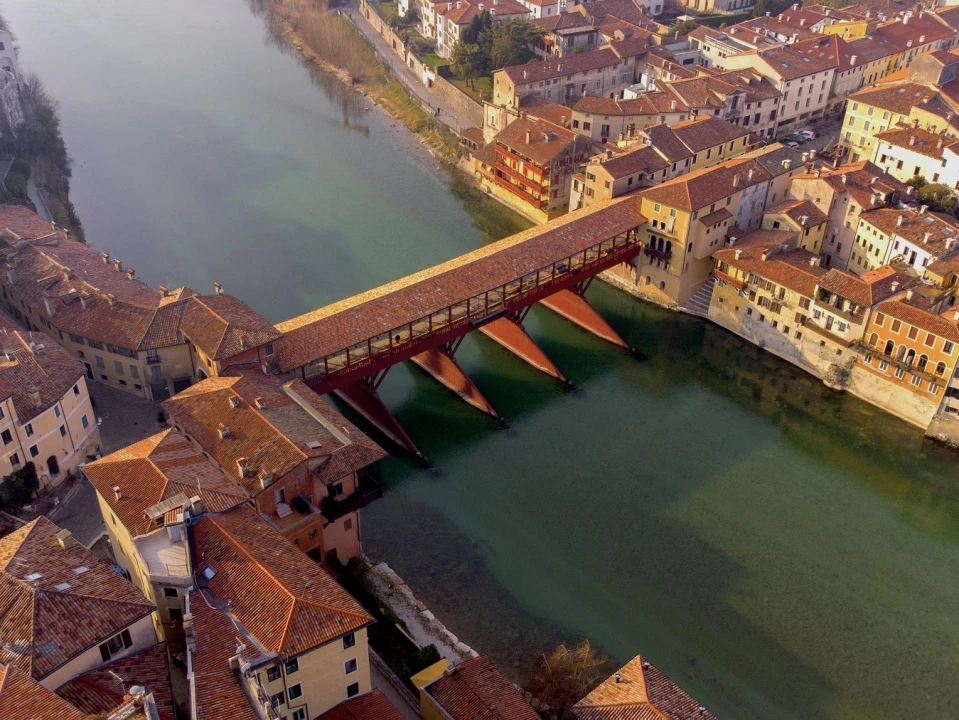

Few landmarks in Italy embody resilience quite like the Ponte degli Alpini in Bassano del Grappa. Known simply as the Ponte di Bassano, this wooden bridge over the Brenta River has been destroyed and rebuilt multiple times across the centuries. Its current appearance, inspired by a 16th century design, hides a turbulent history marked by floods, wars, and human determination.
The first bridge on this site dates back to the 13th century, when Bassano was an important commercial hub linking the Venetian plains with Alpine routes. Built primarily of wood, the structure was practical but vulnerable. The Brenta River, fed by mountain waters, is known for its unpredictable floods, and early versions of the bridge were repeatedly swept away.
The turning point came in 1569, when the Venetian Republic commissioned the architect Andrea Palladio to design a new bridge. Palladio made an unusual choice. Instead of replacing wood with stone, which might seem more durable, he embraced timber but introduced a sophisticated engineering solution. His design used a system of angled supports that allowed the structure to withstand strong currents while remaining flexible. It was both elegant and functional, a hallmark of Palladio’s genius.
Despite this innovation, nature proved relentless. The bridge was destroyed again in 1748 during a particularly violent flood. It was rebuilt following Palladio’s original plans, a decision that established a tradition: every reconstruction would remain faithful to his design, turning the bridge into a living example of architectural continuity.
The Napoleonic Wars brought another dramatic chapter. In 1813, during the retreat of French troops, the bridge was burned to slow advancing enemies. Once again, the people of Bassano rebuilt it, reaffirming its symbolic importance to the town.
Perhaps the most emotional connection to the bridge comes from its association with the Alpini, the elite mountain troops of the Italian army. During World War I, Bassano del Grappa was a strategic location near the front lines. Soldiers crossed the bridge on their way to the mountains, and many never returned. After the war, the bridge became a symbol of their sacrifice, earning the name Ponte degli Alpini.
World War II brought further destruction. In 1945, retreating forces blew up the bridge. This time, its reconstruction became a national effort. Veterans of the Alpini corps played a key role, both symbolically and practically, in rebuilding it. When the bridge reopened in 1948, it was not just an architectural restoration but a powerful act of collective memory.
One of the most fascinating aspects of the bridge is that, despite being rebuilt around eight times, it has never lost its identity. Each version has adhered closely to Palladio’s concept, preserving not only its appearance but also its structural philosophy. This continuity makes the bridge unique: it is both ancient and modern at the same time.
There are also smaller curiosities that add to its charm. At one end of the bridge stands the historic Grapperia Nardini, founded in 1779 and considered Italy’s oldest distillery. For generations, visitors have crossed the bridge and stopped there for a glass of grappa, turning the act of crossing into a ritual.
Another detail often overlooked is the sound of the bridge itself. Being made of wood, it creaks gently underfoot, especially when crowded. For locals, this sound is part of its identity, a reminder that the structure is alive and responsive, not static like stone.
Today, after a major restoration completed in the early 21st century, the Ponte degli Alpini continues to stand as a symbol of endurance. More than just a crossing, it represents the ability of a community to rebuild, again and again, without losing its soul.