
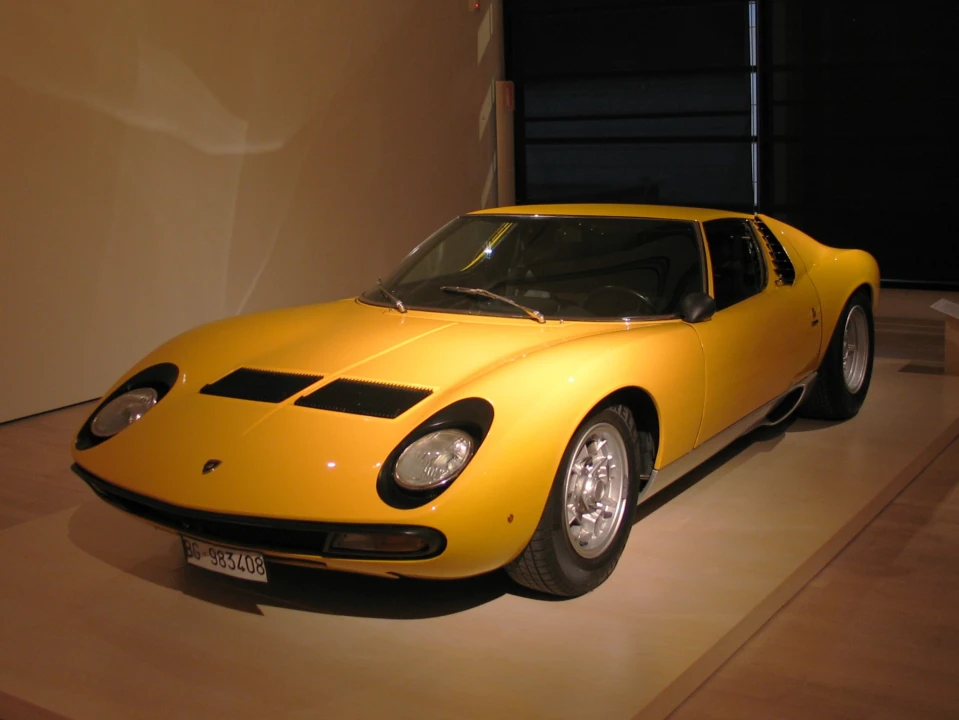

The automobile is a highly evocative and identity–defining product – one of the fields in which Italian design has created some absolute masterpieces. Among these, the Lamborghini Miura certainly stands out, an extremely iconic car that has recently celebrated its 60th anniversary.
It was March 10, 1966, when the new car appeared before the public for the first time at the International Motor Show in Geneva. The car’s full name is Lamborghini P400 Miura, with the letter P indicating the rear engine placement and 400 referring to the 4-liter displacement.
From 1966 to 1968, 265 units of the first version were produced. They were followed by 338 examples of the P400 Miura S between 1969 and 1971 and by 150 Miura SV models built from 1971 to 1973. Among the special versions are the four SVJ models derived from the Miura Jota prototype and the Miura Spider created by Bertone.
The Miura’s shape, designed by the young Marcello Gandini for Carrozzeria Bertone, represents a true sculpture of our time.
The body stands out for extremely bold and innovative solutions, such as the long, low front hood, the front headlights surrounded by the distinctive “eyelashes,” and the extremely low ground clearance of both the car and the roof of the cabin, which sits only 110 centimeters above the asphalt.
At the rear, the large engine hood – integrated with the trunk and fenders – is closed by metal slats that are not only design elements but also help dissipate the heat produced by the engine.
Inside, the cabin is refined and characterized by the two “binocular” gauges for the tachometer and speedometer, with the secondary control levers positioned, in the first series, high up on the roof panel.
Engineered by Giampaolo Dallara and Paolo Stanzani, the Miura was the first true high-performance production road car with a transverse mid-rear engine: a 3.9-liter V12 producing 350 horsepower in its first version.
With that level of power – pushing it to a top speed of 290 km/h – it became the fastest production car in the world at the time.
The beautiful automobile immediately won over the public and soon became almost an emblem of its era – of the dynamic and daring Italy of the 1960s and the years of the Economic Boom.
Many aspects of its history have now taken on the flavor of legend. It is even said that the term “supercar” was coined by journalists precisely to describe the Miura.
It is also said that Ferruccio Lamborghini, the first time he saw the drawings of the new car, uttered the fateful words: “I like this one – with this we will enter legend.”
The Miura can almost be considered the manifesto of the relationship that the extraordinary entrepreneur from Emilia had with the future.
Vincenzo Borgomeo wrote brilliantly in La Stampa on March 10, 2026:
“Ferruccio Lamborghini, it is said, could not stand the dust of the past. ‘Old stuff dies in the homes of fools,’ he often repeated, throwing away anything that was more than five years old. Furniture, objects, but above all ideas, habits, compromises. A man who lived as if the future were already late, and the present an offense that had to be corrected immediately.”
The Miura quickly acquired an iconic status, captivating entertainment stars and public figures in Europe, the United States, and the rest of the world.
Many films have featured it, but its role in the 1969 movie The Italian Job, in which Rossano Brazzi drives his orange Miura along the Great St. Bernard Pass while accompanied by the soundtrack “In Days Like These” by Matt Monro, remains unforgettable – a scene that is still one of the most admired and recognizable in the history of automotive cinema.
We can again quote the remarkable article by Vincenzo Borgomeo mentioned earlier: “Everyone wanted it. Everyone who mattered, at least. Frank Sinatra bought an orange one and drove it around Los Angeles as if he were trying to escape himself.”
And again: “Dean Martin had a blue one parked in front of his villa with the nonchalance of someone who already has everything. Miles Davis almost played it, with that engine reminding him of his saxophone. Elton John, Rod Stewart, the Prince of Bahrain, the Shah of Iran, even the King of Saudi Arabia – the Miura became the passport that opened the doors of the world.”
Shortly before the Miura was born – indeed when it was already practically in gestation – Herbert Marshall McLuhan wrote: “The automobile has become an article of clothing without which we feel naked, uncertain, and incomplete” (Understanding Media, 1964).
Remaining within the metaphor of the brilliant Canadian sociologist and philosopher, we might say that the Miura introduced into the wardrobe of the contemporary world a garment that had never existed before – a piece of clothing with a revolutionary cut, irresistibly fascinating and exclusive.
Today the automotive sector, throughout the Western world, is experiencing a period of profound transformation and serious challenges.
The 60th anniversary of the Lamborghini Miura arrives almost like a good omen – an anniversary that seems to trace a path for the future of the industry.
Design, as the great examples of the past teach us, can be the tool for shaping a future of development and progress.
Ferruccio Lamborghini himself once said: “The past is important for history, but we must always look to the future.”