

The invention of the ballpoint pen is attributed by some sources to American lawyer and leather tanner John J. Loud, who obtained U.S. Patent No. 392,046 on October 30, 1888.
The patent described the following writing instrument: “My invention consists in an improved reservoir or fountain pen, particularly useful, among other purposes, for marking upon rough surfaces such as wood, coarse wrapping paper, and other articles where an ordinary pen could not be used.”
More commonly, however, the birth of the ballpoint pen is associated with an idea developed by Hungarian journalist, later naturalized Argentine citizen, László József Bíró.
According to legend, he came up with the concept while watching a group of children playing marbles in a puddle: once the marbles rolled out of the water, they left behind a smooth, regular wet trail on the ground.
Because of his work, Bíró needed a writing instrument that could write quickly and continuously, while fountain pens required constant refilling and careful handling to avoid ink stains.
Starting from that simple observation, the journalist developed a small steel ball placed at the tip of a tube, capable of transferring ink onto paper as it rotated.
Bíró patented the invention in Great Britain on June 15, 1938, effectively creating the modern ballpoint pen, which in many countries is still called a “biro” in his honor.
An important step in the spread of the product came when the British Royal Air Force decided to purchase large quantities of the pens.
At high altitudes, where fountain pens became unreliable, the ballpoint mechanism continued to function effectively, offering pilots a dependable solution.
But the ballpoint pen truly took metaphorical flight, becoming the everyday object that has accompanied generations, only after World War II, thanks to Baron Marcel Bich.
His family, originally named Bicchi, came from Siena and had settled in Châtillon, where the surname was modified.
Attorney Jean-Jacques Pantaleon Bich, mayor of Châtillon in the early 19th century, married Philippine Passerin d’Entrèves, heir to the local feudal family.
Their son Emmanuel Bich was born in Châtillon in 1800. He graduated in medicine in Turin, furthered his studies in Paris, became mayor of Aosta, and was granted hereditary baron status in 1841 by King Charles Albert.
His grandson Aimé-Mario Bich attempted to revive the family fortunes through industry, but with limited success. He eventually sought new opportunities in France, settling in Paris with his family, including his son Marcel, born in Turin on July 29, 1914, at 60 Corso Re Umberto.
After acquiring Bíró’s patent, Marcel Bich refined the manufacturing process of the ballpoint pen, drastically lowering production costs. In 1950, he launched the BIC brand – a shortened version of his surname chosen to avoid pronunciation mistakes.
The launch of the BIC Cristal ballpoint pen, sold at the affordable price of 50 centimes, was an extraordinary success: since its introduction, more than 100 billion units have been sold worldwide.
Today, the ballpoint pen is universally regarded as a design object, so much so that it is displayed in prestigious museums such as the Centre Pompidou and the Museum of Modern Art.
In 2025, to celebrate the 75th anniversary of the BIC Cristal, the company chose to mark the occasion with an unexpected reinterpretation: the creation of a lamp directly inspired by the pen.
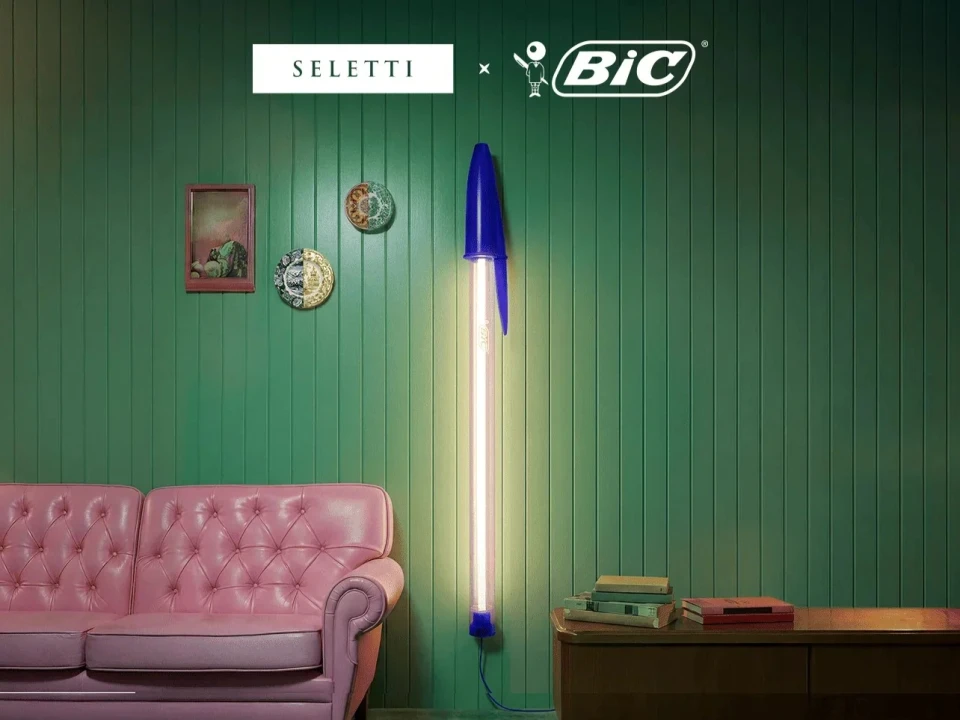
Presented in Paris in 2026, the BIC Lamp, designed by Mario Paroli, was born from the collaboration between BIC and Seletti.
In the design world, there was probably no more fitting partner for BIC than Seletti, a company known for its playful spirit, irony, and lighthearted creativity.
The lamp faithfully reproduces the silhouette of the BIC Cristal on a much larger scale. The transparent body becomes a light diffuser, while the ink cartridge is replaced by an LED tube.
This transformation highlights the strength of the original design: without altering its essential features, the BIC Cristal changes function and effortlessly enters the field of interior design.
What is especially striking about the BIC Lamp is its fidelity to the original. It appears as a giant BIC Cristal reproduced at a 12:1 scale, recreated with almost philological attention to detail, from the cap to the transparent barrel.
Only instead of ink, there is an LED light source, transforming it into a floor lamp, hanging lamp, or wall sconce.
The project is perfectly in line with Seletti’s spirit: the goal was not to reinvent the icon, but to amplify its voice in an original way, unexpectedly bringing it into domestic spaces.
Here, the BIC Lamp – strongly evocative of the ballpoint pen that accompanied generations of students and office workers – becomes a presence that is at once deeply familiar and surprisingly disorienting.
The BIC Lamp project can be considered an emblematic example of contemporary design, understood not only as a tool for stylistic and functional solutions, but also as a vehicle for emotions, messages, and meaning.