

Italy’s modern nightclub culture began long before electronic dance music became a global industry. From the 1960s onward, Italian clubs combined music, architecture, fashion, theater, and visual experimentation, creating spaces in which going out was not simply entertainment – it was a cultural performance.
One of the earliest symbols of this transformation was the Piper Club in Rome. Opened in 1965 inside a former movie theater, the Piper was inspired by the clubs of London and New York but quickly developed a distinctive Italian identity. Its colorful interiors, movable furnishings, projected images, and live performances attracted a generation eager to leave postwar conventions behind.
The Piper became closely associated with Patty Pravo, who was initially known as “the Piper girl,” and welcomed Italian and international performers. Pink Floyd, Jimi Hendrix, and numerous protagonists of the Italian beat movement appeared there. Music, fashion, art, and celebrity culture met under one roof, turning the club into a laboratory for the emerging youth culture.
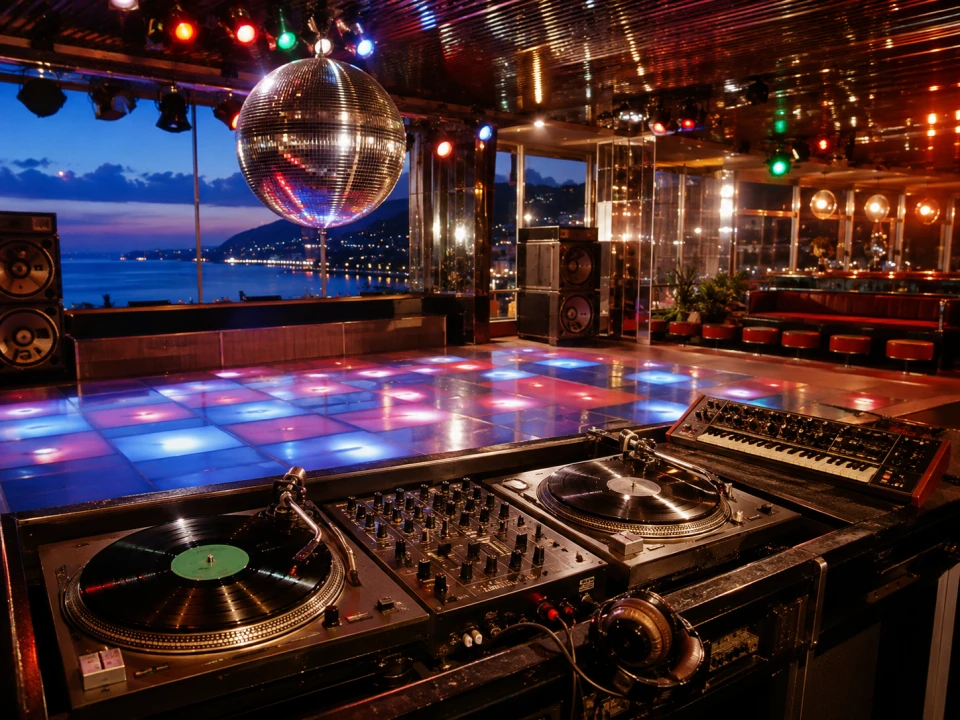
During the following decade, the center of innovation moved toward the Adriatic coast. In 1975, Baia degli Angeli opened near Gabicce Mare. Built on a hill overlooking the sea, the club featured futuristic architecture, glass walls, illuminated dance floors, and elevators that allowed DJs to move between different booths.
American DJs Tom Sison and Bob Day introduced Italian audiences to mixing techniques and musical selections influenced by New York’s disco scene. They treated records as elements of a continuous journey rather than as separate songs. Daniele Baldelli, who later became one of Italy’s most influential DJs, continued developing this approach after working at the Baia.
Baia degli Angeli opened 2 years before Studio 54 in New York and became one of Europe’s most glamorous nightlife destinations. Its influence extended far beyond its short original life. It helped redefine the DJ as an artist responsible for building the entire emotional rhythm of an evening.
Italian clubs soon began cultivating their own sounds. At the Cosmic in Lazise, near Lake Garda, Baldelli created what became known as “cosmic music.” His sets combined electronic experimentation, African rhythms, funk, Brazilian music, European pop, and records played at unexpected speeds. The result was neither conventional disco nor rock, but a musical universe assembled inside the DJ booth.
The Riviera romagnola subsequently became Italy’s great nightlife capital. Rimini, Riccione, and neighboring coastal towns offered hundreds of dance venues, hotels, restaurants, and late-night attractions. Clubs such as Paradiso, Byblos, L’Altro Mondo Studios, and later Cocoricò helped turn summer tourism into a continuous spectacle.
Cocoricò, inaugurated in Riccione in 1989, became especially important during the 1990s. Its transparent pyramid, theatrical performances, and adventurous programming made it a temple of house, techno, and Italian rave culture. The club demonstrated that nightlife could possess an artistic identity as recognizable as that of a theater or fashion house.
Meanwhile, Italian producers were conquering international radio stations and dance floors. Giorgio Moroder, born in South Tyrol and active in Munich, helped revolutionize disco through synthesizers and electronic production. His work with Donna Summer, particularly “I Feel Love,” provided a foundation for generations of dance music.
During the 1980s, the term “Italo disco” came to describe a broad family of Italian-made electronic dance records characterized by synthesizers, drum machines, melodic hooks, and frequently English-language lyrics. Songs by Gazebo, Ryan Paris, Righeira, Den Harrow, and Sabrina became international hits. Tracks such as “I Like Chopin,” “Dolce Vita,” and “Vamos a la playa” carried an unmistakable mixture of romance, technology, and Mediterranean fantasy.
Italo disco was sometimes dismissed as lightweight popular music, yet its influence proved remarkably durable. Its synthetic bass lines, bright melodies, and mechanical rhythms contributed to the development of house, techno, synth-pop, and contemporary electronic music.
From the Piper’s beat generation to the futuristic Baia degli Angeli, Italy’s nightclubs were never merely rooms for dancing. They were stages on which Italians experimented with sound, design, identity, and freedom. When Italy danced, much of the world eventually followed.