
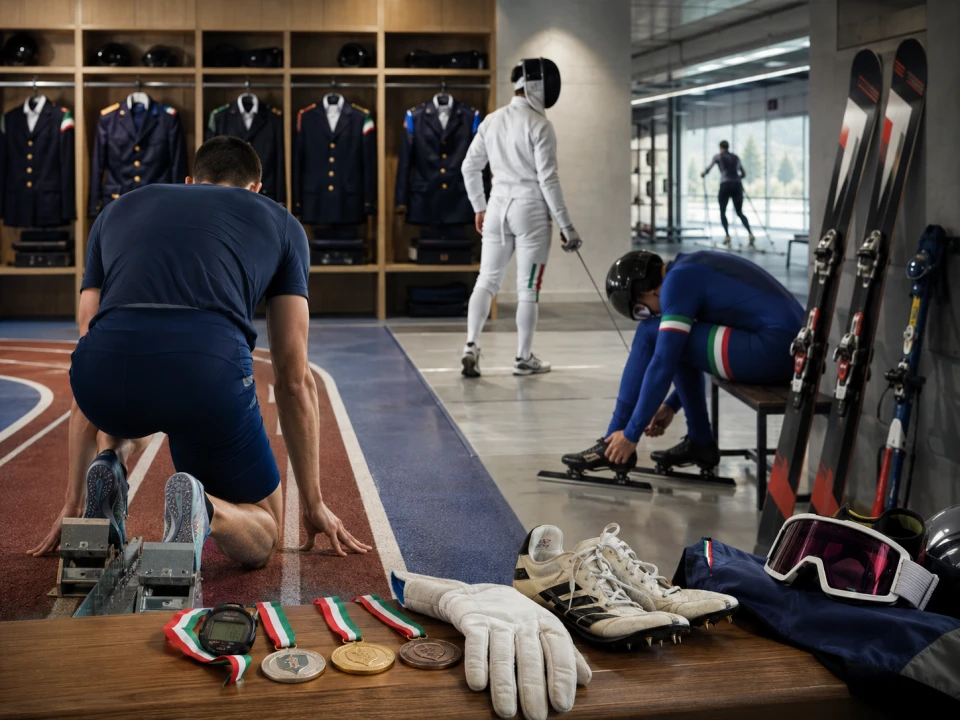

When Federica Brignone raised her arms after winning super-G gold at the Milano Cortina 2026 Olympic Winter Games, the emblem of Italy’s national team was not the only insignia on her racing suit. Brignone is a marshal in the Carabinieri. A few hours earlier, Francesca Lollobrigida had won gold in the 5,000-meter speed skating event – she is a Senior Airman in the Italian Air Force.
Marcell Jacobs, who won gold in the 100 meters and 4x100-meter relay in Tokyo, wears the uniform of the Italian State Police. Sofia Goggia, the strongest Italian skier of her generation, competes for the Fiamme Gialle, the sports division of the Guardia di Finanza, Italy’s financial police.
To an American audience accustomed to a system in which Olympic athletes are collegiate student-athletes, sponsored professionals, or, at best, recipients of grants from the U.S. Olympic & Paralympic Committee, all of this may sound almost surreal: how can a country produce world champions through its police and military? Yet this is precisely the hidden machinery behind decades of Italian medals, and it is one of the most distinctive – and least understood abroad – features of Italy’s entire sports system.
Italy has eight Military and State Sports Groups: four belong to the Armed Forces – the Army, Navy, Air Force, and Carabinieri – and four to state law enforcement and public safety agencies – the State Police, with its famous Fiamme Oro; the Guardia di Finanza, with the Fiamme Gialle; the Penitentiary Police, with the Fiamme Azzurre; and the National Fire and Rescue Service, with the Fiamme Rosse.
The mechanism is as simple as it is effective. An athlete who has already demonstrated talent at the national or international level may enter a public recruitment competition, often specifically reserved for athletes, to join one of these organizations. Once recruited, the athlete becomes a full member of the military or police force: they hold a rank, receive a fixed government salary and retirement benefits, and, most importantly, have the time and facilities needed to train at the highest level. In return, athletes represent their organization in competitions, wear its uniform at ceremonies, and enhance the institution’s sporting prestige.
This is not a colorful footnote – it is the economic backbone of individual sports in Italy. In a country where track and field, fencing, swimming, martial arts, and alpine skiing do not generate the same television and sponsorship revenue as soccer, the government has found a way to provide a stable income to tens of thousands of athletes who otherwise could not afford to train full time.
In the United States, the typical path to the Olympic elite runs through the NCAA college system, private sponsorships, or the often limited support of the U.S. Olympic & Paralympic Committee. It is a model driven by private competition and the market: athletes who cannot find a sponsor often walk away from their sport.
The Italian model reverses that logic: the government itself becomes the athlete’s employer. The advantages are clear. First, continuity: a gymnast or fencer can train for 10 or 15 years without worrying about paying the rent, because the salary continues whether the athlete wins or loses. Second, facilities: military sports centers provide gyms, pools, and professional-level medical and coaching staffs, often better than those available through civilian sports federations. Third, post-career security: when competitive activity ends, athletes do not suddenly find themselves unemployed. They can continue within the organization as instructors, officers, or in other roles, or leave with the retirement benefits they have earned.
As a result, Italy can cultivate athletes in disciplines that would be financially unsustainable elsewhere: fencing, rowing, modern pentathlon, weightlifting, shooting, bobsled, and cross-country skiing. The least commercial sports – those without multimillion-dollar contracts – benefit the most from this government safety net.
The figures from the two most recent Olympic Games make the scale of the phenomenon difficult to ignore.
At Paris 2024, more than 70% of Italy’s 403 athletes wore a military uniform or belonged to a civilian state agency. Of Italy’s 40 total medals – 12 gold, 13 silver, and 15 bronze, its best haul ever – the State Police alone, through its Fiamme Oro sports group, contributed 18 medals: five gold, six silver, and seven bronze. That represented about 45% of all podium finishes earned by athletes from state sports groups. If the Fiamme Oro had competed as a separate country, it would have ranked 15th in the overall medal table, ahead of nations such as Spain and Sweden.
At Milano Cortina 2026, more than 60 of the 196 athletes on the Italian team came from the Armed Forces’ Military Sports Groups. Of Italy’s 30 total podium finishes – good for fourth place in the overall medal table and the country’s best result ever at the Winter Games – 18 medals, including eight gold, three silver, and seven bronze, were earned by athletes from the Defense Sports Groups. Additional medals came from competitors representing the Guardia di Finanza and State Police. In practical terms, well over half of Italy’s Milano Cortina medal haul passed through a military or police barracks.
Not everyone in Italy views this system with unconditional admiration. Criticism comes primarily from civilian sports clubs and federations that lack access to this kind of government support. The first argument is economic: private clubs often discover and develop young talent during the earliest stages of an athlete’s career, yet they cannot retain those athletes once they reach a certain level and are absorbed by military sports groups offering salaries no amateur club can match. In other words, one institution – the civilian club – does the scouting and youth development, while another – the military or police organization – receives the prestige associated with the medal.
The second argument concerns the distortion of domestic competition. In many individual sports, national championships effectively become contests among institutional colors – Fiamme Oro versus Fiamme Gialle versus the Army – rather than competitions among traditional sports clubs, relegating civilian organizations to a marginal role as little more than talent nurseries.
Third, there is a broader debate over whether the government should invest public resources in a model that effectively selects an elite group of athletes who are already competitive instead of expanding access to grassroots sports, which remain underfunded in Italy. Despite the criticism, the numbers are clear: without the Military Sports Groups, Italy would not be the Olympic power it is today, consistently ranking among the top 10 nations in the medal table since Atlanta 1996. The system grew out of a characteristically Italian compromise, bringing the government, law enforcement, the military, and sports together within a single structure. Yet it ultimately solved a problem that many other countries, including the United States, have never fully addressed: how to give an elite athlete in a sport that does not make headlines every day the opportunity to train and live with dignity throughout an entire career.
For American observers accustomed to viewing the military and elite sports as two separate worlds, Italy offers an almost unique case: a country where the quiet engine behind its Olympic medal count is neither a college nor a sponsor, but a military or police barracks.