

In the green heart of Italy, high above the Umbrian valley, Perugia holds a world record that speaks not of speed, size, or spectacle, but of cultural hospitality. The University for Foreigners of Perugia is Italy’s oldest institution devoted to teaching, studying, and promoting the Italian language and civilization for international learners.
Its story began in 1921, when Perugian lawyer Astorre Lupattelli created advanced culture courses designed to introduce visitors to Umbria and Italy. The program presented the region’s history, institutions, landscape, and artistic heritage to students arriving from beyond Italy’s borders. Italian language courses followed in 1922, forming the nucleus of a university with an unusually international mission.
In 1925, royal decrees formally established the Regia Università Italiana per Stranieri, or Royal Italian University for Foreigners. Its purpose was ambitious: to spread knowledge of Italy through its language, literature, arts, history, customs, institutions, industry, and ideas. At a time when international travel was far less accessible than it is today, Perugia was already building a meeting place for cultures.
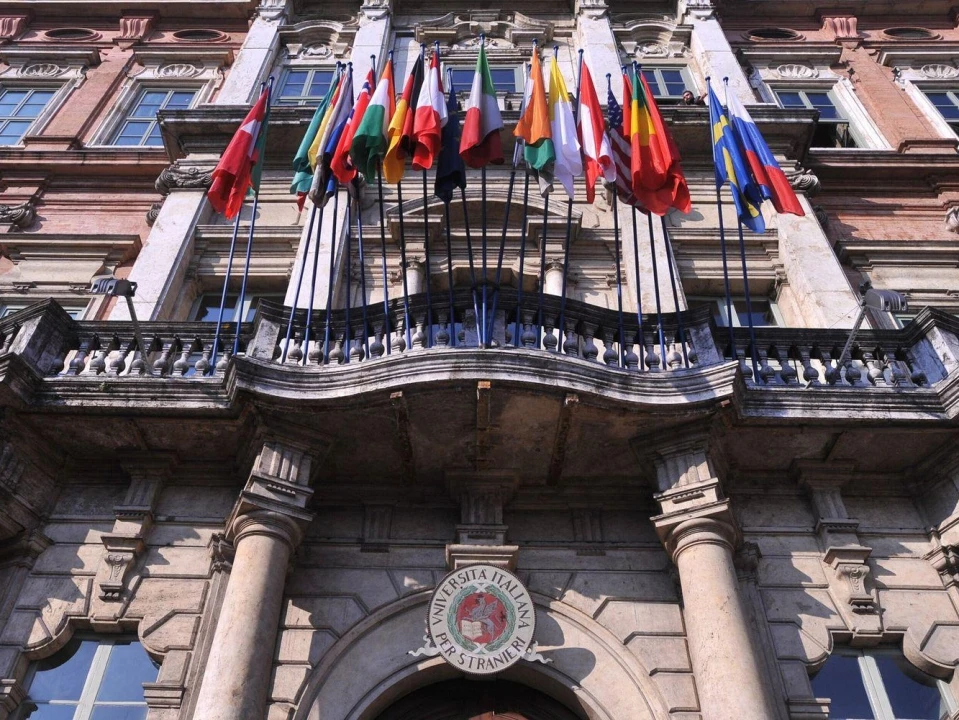
The university’s first classes were held in rooms belonging to the historic University of Perugia and in the Sala dei Notari inside Palazzo dei Priori. Since 1927, its home has been Palazzo Gallenga, an elegant eighteenth-century residence near the monumental Etruscan Arch. From this distinguished setting, generations of students have stepped directly into the narrow streets, stone stairways, cafés, and piazzas of one of Italy’s best-preserved medieval cities.
This location is more than a beautiful backdrop. Perugia itself becomes part of the classroom. Students hear Italian at the market, practice it over coffee, encounter centuries of art and architecture, and experience the rhythms of everyday life in Umbria. Language learning here is inseparable from cultural immersion.
Over the decades, the University for Foreigners has welcomed people from around the world, earning a reputation as a laboratory of intercultural education. Its work has expanded beyond language instruction to include research, teacher training, certification, undergraduate and graduate degrees, and programs in communication, international relations, and the promotion of Italian culture. In the 1990s, it gained parity with Italy’s state universities, strengthening its role within the national higher-education system.
Yet its essential identity remains unchanged. The university exists to connect Italy with the wider world and to encourage dialogue across languages and traditions. Students may arrive for grammar, literature, art, music, cinema, or professional development, but they also enter a community shaped by curiosity and exchange.
Its alumni form a living international network. After returning home, many become teachers, translators, diplomats, researchers, artists, entrepreneurs, or lifelong ambassadors for Italian culture. Their memories of Perugia carry the university’s mission far beyond Umbria. In this sense, every classroom creates new connections between Italy and communities on every continent, one conversation and lasting friendship at a time.
More than a century after Lupattelli’s first courses, Perugia’s record still matters. This university did not simply teach foreigners how to speak Italian. It turned the Italian language into a bridge—and made an ancient hill town a global crossroads.