

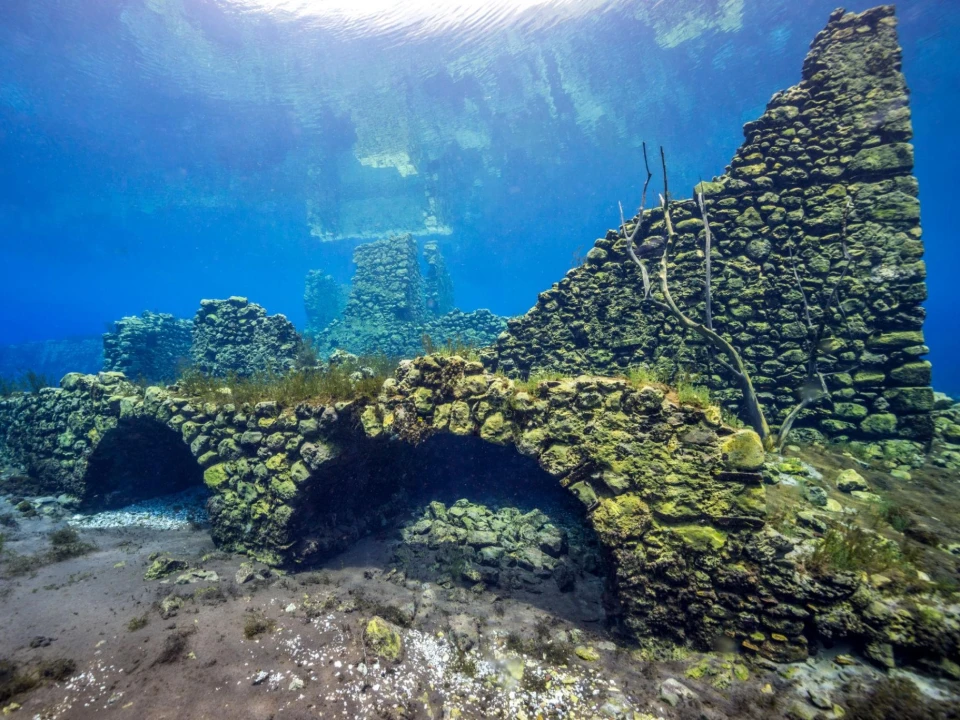

Near the historic town of Capestrano, in the province of L’Aquila, a small body of water conceals one of the most unexpected landscapes in Abruzzo. Lake Capodacqua appears quiet and modest from the surface, but beneath its exceptionally clear water lie stone walls, pathways, trees and the remains of old watermills.
The lake is located in the Tirino Valley, below the Gran Sasso massif. Its name derives from the Latin expression “caput aquae,” meaning the head or source of the water. Capodacqua is fed by powerful natural springs connected to the vast underground water system of the Gran Sasso. These springs constitute one of the principal sources of the Tirino, a river celebrated for the clarity of its water.
For centuries, the constant flow of water supported a small rural settlement. Local communities built mills near the springs to harness their energy. Water turned large wheels that powered millstones, transforming locally grown wheat and other grains into flour. The mills were therefore essential parts of an agricultural economy in which water, farmland and human labor remained closely connected.
The landscape changed dramatically in 1965, when a dam was constructed to create a reservoir for irrigating the fields of the Tirino Valley. As the water level rose, it covered old buildings, lanes and vegetation. Two stone mills associated with the Verlengia family disappeared beneath the surface, while part of a former paint-making facility remained above the waterline.
Unlike many flooded structures, the mills did not vanish into darkness or mud. The continuous movement of cold spring water limits the accumulation of sediment and excessive aquatic vegetation. With temperatures remaining close to 50°F, visibility can be extraordinary. Walls, arches, millstones, channels and tree trunks can be seen resting in a blue-green environment that seems suspended outside time.
This preserved underwater landscape has earned Capodacqua the nickname “the little Atlantis of Abruzzo.” Divers descend to depths of approximately 30 feet and move among the ruins as brown trout pass through empty windows and above former pathways. One mill remains relatively well preserved, although the structures have experienced natural deterioration and damage associated with the 2009 L’Aquila earthquake.
Capodacqua is not an ordinary recreational lake. The area is privately managed and environmentally protected, and swimming is prohibited. Diving must be organized through authorized operators and conducted according to conservation rules. In some periods, low-impact excursions aboard electric boats with underwater viewing sections have allowed visitors to observe the submerged landscape without entering the water.
The lake also belongs to a much larger historical setting. Nearby Capestrano is known for its medieval castle, the Abbey of San Pietro ad Oratorium and the famous Warrior of Capestrano, a sixth-century BC Italic statue discovered in the surrounding countryside in 1934.
Capodacqua reveals another kind of Italian heritage – one created by nature, agricultural history and modern engineering. Its submerged mills recall a vanished rural world, preserved not in a museum but beneath the remarkably transparent waters of Abruzzo.