
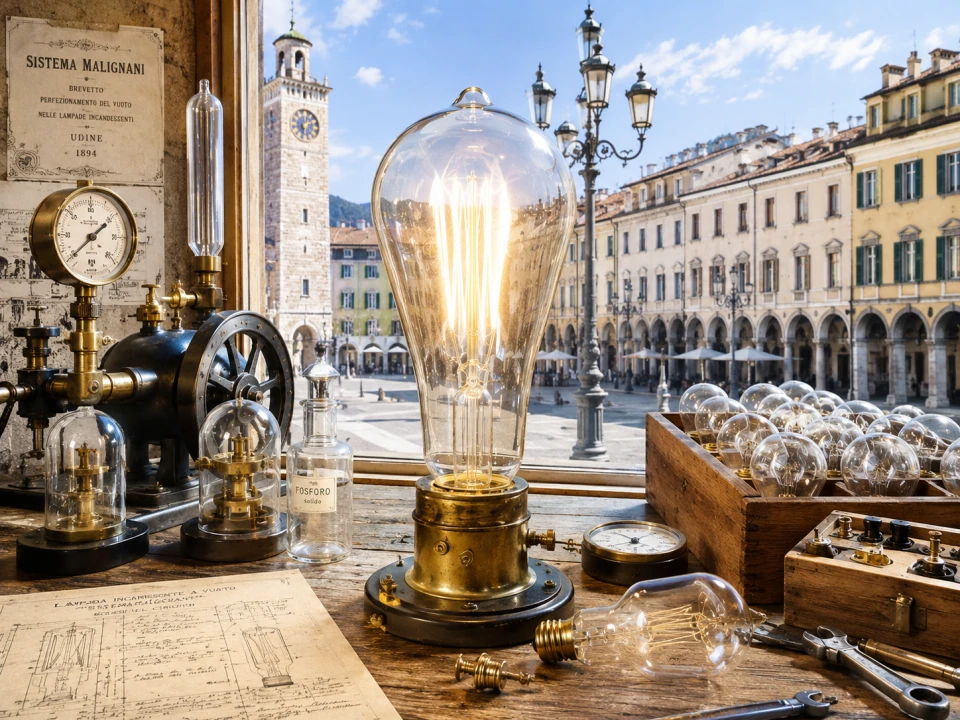

The history of the electric light bulb is usually associated with Thomas Edison. But in Udine, in northeastern Italy, a young inventor named Arturo Malignani solved one of the technology’s most stubborn problems so effectively that Edison eventually sent an engineer to investigate what the Italian was doing.
Born in Udine in 1865, Malignani grew up around photography, chemistry, optics, and glasswork. He became fascinated by electric lighting when demonstrations reached his hometown in the early 1880s. Edison had already developed a commercially viable incandescent lamp, but early bulbs remained expensive to manufacture and suffered from a crucial weakness – creating and maintaining a sufficiently good vacuum inside the glass bulb.
Malignani attacked precisely that problem.
By 1888, he had developed techniques that dramatically improved the evacuation of incandescent bulbs. His most important innovation combined mechanical evacuation with phosphorus used as a “getter,” removing residual gases that remained after pumping. He also devised equipment capable of evacuating multiple bulbs simultaneously rather than treating them individually.
The consequences were enormous. Better vacuum meant longer-lasting filaments, while simultaneous processing made manufacturing faster and cheaper. Contemporary accounts credited Malignani’s lamps with exceptionally white light and lifetimes reaching roughly 800 hours.
Udine became his extraordinary real-world laboratory. In 1888, Malignani and his partners obtained the contract for the city’s electric public lighting system, and on January 1, 1889, hundreds of incandescent lamps illuminated Udine. The relatively small Friulian city, then home to roughly 20,000 people, suddenly found itself among Europe’s pioneers of electric urban lighting.
Yet Malignani initially underestimated his own achievement. He apparently assumed that major foreign inventors must already possess superior technology. Only later did he patent his vacuum-production process, obtaining an Italian patent in January 1894. A U.S. patent application followed that August, and U.S. Patent No. 537,693 was granted on April 16, 1895.
Then the remarkable reversal occurred.
It was not Malignani desperately chasing Edison for recognition. Edison’s organization became interested in Malignani. Historical accounts report that Edison sent technicians to Udine to verify the Italian inventor’s results. One particularly fascinating episode involved Edison engineer John White Howell, who was traveling through Europe and visited Udine to examine Malignani’s bulbs and process.
What he found was convincing enough to bring the Friulian inventor to America.
Malignani crossed the Atlantic aboard the City of Rome, arriving in New York in October 1895. He subsequently met Edison in New Jersey and demonstrated the process whose value had first emerged in his Udine workshop. Edison’s organization acquired the exploitation rights. One contemporary reconstruction places Malignani’s payment at $30,000 – an extraordinary fortune in the 1890s.
Malignani had not invented Edison’s incandescent lamp. His contribution was different and crucial: he developed a superior industrial method for producing the vacuum that allowed incandescent lamps to work more efficiently, reliably, and economically.
And the light bulb was only part of his story. Malignani pioneered hydroelectric development in Friuli, worked on power stations, promoted Udine’s electric tram system, experimented with an electric automobile around 1890–1891, and maintained a meteorological observatory.
That makes Udine essential to the story. Far from the great industrial laboratories of America, a young Italian experimented until he found a solution important enough that Edison’s people crossed Europe to see it.
In the history of Italian invention, few stories reverse expectations quite so beautifully: this time, America came looking for the inventor in Italy.