
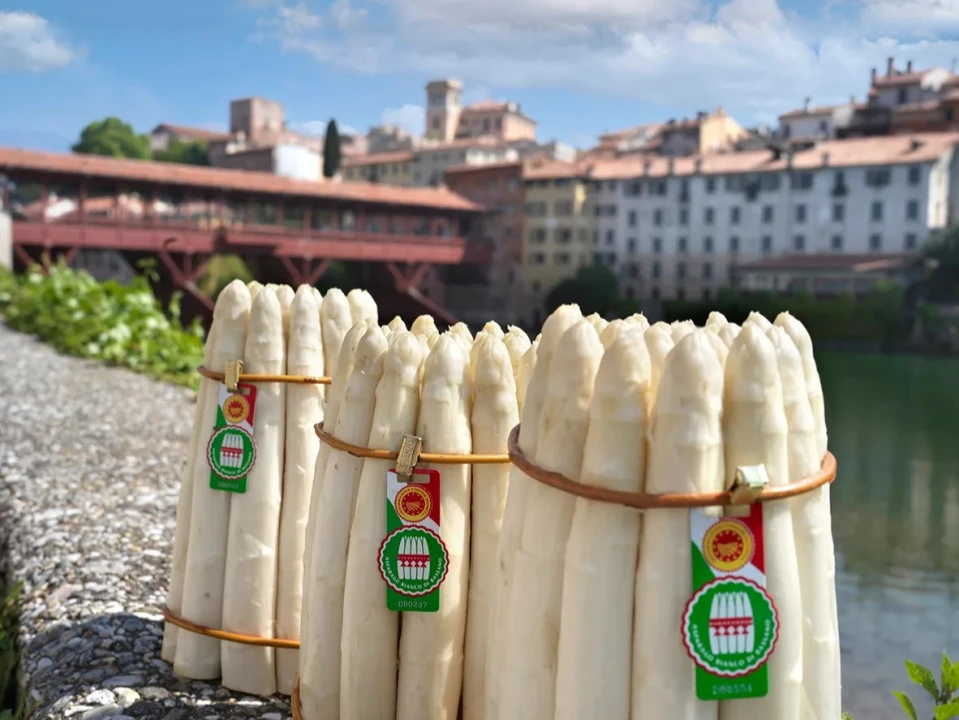

In the Veneto countryside, at the foot of the Venetian Prealps, spring brings one of Italy’s most distinctive vegetables. Asparago Bianco di Bassano DOP is not simply white asparagus. Its unusual color, delicate texture, slightly sweet and bitter flavor, and centuries-old connection with the area around Bassano del Grappa make it an extraordinary expression of how Italian agriculture can transform geography into flavor.
The asparagus comes from the local “Comune” or “Chiaro di Bassano” ecotype. Unlike green asparagus, its edible shoots develop underground, away from sunlight. Without light, photosynthesis and the production of chlorophyll are prevented, allowing the shoots to retain their characteristic pale color. The result is an asparagus that is tender, remarkably low in fiber, and recognizable for its subtle balance between sweetness and a pleasantly bitter note.
Its identity begins beneath the soil. The production area lies along the Brenta River and consists largely of alluvial soils created over centuries by deposits of gravel, sand, and silt. These loose, well-drained soils allow the asparagus plant to develop an extensive root system. The local microclimate is influenced by the Brenta, while the Venetian Prealps and Monte Grappa provide geographical protection. Together, these conditions contribute to the rapid development, tenderness, and low fibrousness of the shoots.
And this is a genuinely local treasure. The DOP production zone is restricted to 10 municipalities in the province of Vicenza: Bassano del Grappa, Cartigliano, Cassola, Marostica, Mussolente, Pove del Grappa, Romano d’Ezzelino, Rosà, Rossano Veneto, and Tezze sul Brenta. European Protected Designation of Origin status was obtained in 2007, formally linking the product’s identity to this small corner of Veneto.
Even harvesting reflects tradition. The asparagus is picked by hand, traditionally beginning around St. Joseph’s Day on March 19, with the season continuing into late spring. Producers harvest frequently, often in the early morning, because timing is essential for maintaining freshness and keeping the tips tightly closed.
The official specifications are remarkably precise. DOP asparagus must generally measure between 18 and 22 centimeters, have a minimum central diameter of 11 millimeters, and be tender, intact, and predominantly white. After selection, the spears are traditionally gathered into bundles and tied with a “stroppa,” a young willow shoot. Each certified bundle carries a numbered seal that ensures traceability back through the production chain.
In the kitchen, Bassano’s white asparagus is traditionally treated with restraint. Its delicate flavor does not need complicated preparation. One of the territory’s emblematic combinations is “asparagi e uova” – tender white asparagus accompanied by eggs – allowing the vegetable itself to remain the centerpiece.
Asparago Bianco di Bassano represents something larger than a seasonal delicacy. Its whiteness comes from the way it grows, its texture from the soil beneath it, and its character from a microclimate found in a remarkably limited territory.
In Veneto, spring has a flavor – and, in Bassano, its color is white.