

Bologna is famous for tortellini, mortadella, and ragù, but the surrounding area also leads a less visible global industry: machines that produce gelato. The concentration of manufacturers, technical knowledge, training centers, and suppliers around the city has earned the territory the nickname “Ice Cream Valley.” Its influence reaches gelato shops, restaurants, hotels, and international chains worldwide.
The story began with Bologna mechanic Otello Cattabriga. In 1927, he founded Officine Meccaniche Otello Cattabriga and developed a motorized machine that reproduced the gelato maker’s manual scraping and spreading movements. His invention reduced physical labor while improving consistency, helping transform gelato production from a demanding craft into a more scalable business.
During the 1930s, engineer Bruto Carpigiani refined the concept. He designed the Autogelatiera, an automatic machine featuring a sealed gearbox and a rotating helical blade that made production faster and more hygienic. Bruto died in 1945 at age 42, before seeing his invention manufactured. In 1946, his brother Poerio established Carpigiani Bruto Macchine Automatiche with 50,000 lire in capital, a 20-square-meter workshop, and 12 employees.
The company expanded rapidly during the postwar economic boom. New technologies arrived in the 1960s, including equipment for soft-serve ice cream and the Hard-O-Matic batch freezer. Carpigiani entered the United States in 1964 through Coldelite USA and acquired Cattabriga in 1971. The historic rivals eventually became part of the same industrial group, preserving separate brands while combining production expertise.
Today, Carpigiani is headquartered in Anzola dell’Emilia, outside Bologna, and controls roughly 35% of the worldwide market for artisanal gelato and soft-serve equipment. Recent company accounts have placed annual revenue above €150 million, while a 2022 profile reported €165 million. The company has produced more than 1 million machines and operates a service network of 500 specialized centers across 110 countries.
Bologna’s leadership depends on more than manufacturing. Carpigiani Gelato University, founded in 2003, trains aspiring gelato makers in recipes, food safety, production methods, pricing, and business planning. Its international campuses help customers adapt Italian techniques to different ingredients, climates, and consumer preferences. The company also opened the Gelato Museum in 2012 inside a renovated 2,200-square-meter section of its Anzola headquarters.
The cluster also includes specialists in refrigeration, stainless-steel components, electronics, display cases, and food-processing systems. This nearby supply chain shortens development times and supports continual experimentation. Knowledge circulates among engineers, technicians, gelato makers, and instructors, giving manufacturers an advantage that is difficult for isolated competitors to reproduce.
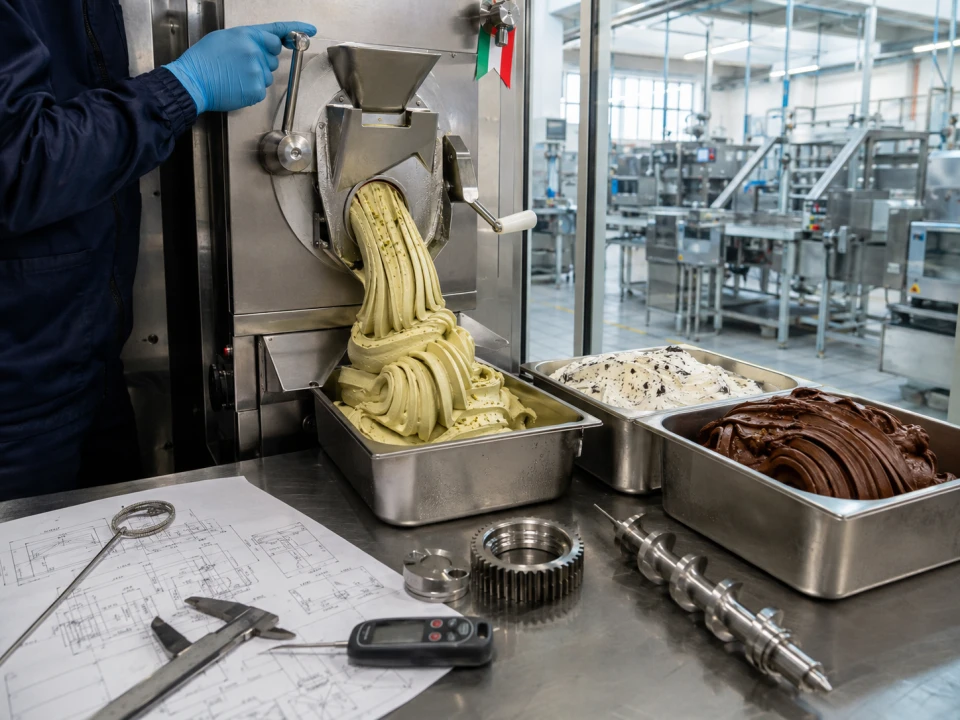
This combination of machinery, education, maintenance, and cultural promotion explains the district’s durability. A professional batch freezer is not simply an appliance: it must control temperature, incorporate the right amount of air, maintain texture, and deliver consistent results throughout demanding service hours.
The “Ice Cream Valley” demonstrates how Emilia Romagna turns food traditions into advanced industry. Bologna does not merely export gelato as an Italian symbol – it exports the technology, training, and technical support that allow entrepreneurs worldwide to produce it. Behind countless display cases filled with pistachio, chocolate, and stracciatella lies a sophisticated manufacturing system developed near Bologna.