
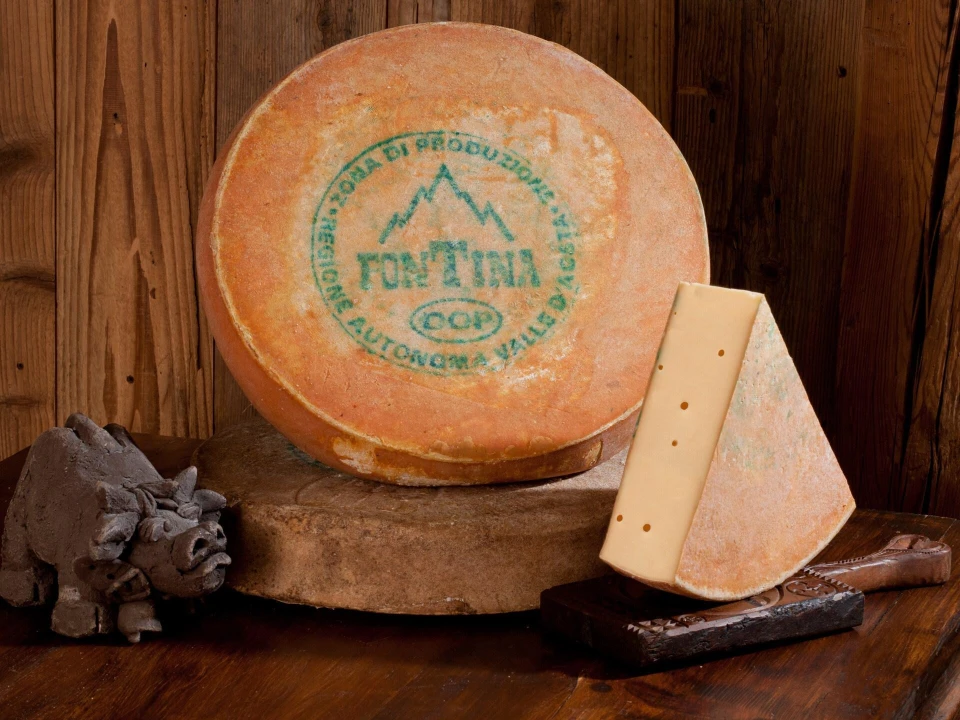

Fontina from the Aosta Valley is one of Italy’s most distinctive and deeply rooted cheeses, a product that perfectly reflects its mountainous homeland. Produced exclusively in the alpine region of Valle d’Aosta in northwestern Italy, Fontina is a protected designation of origin (PDO) cheese, meaning every stage of its production must take place within this specific territory. Its identity is inseparable from the landscape, the climate, and the centuries-old traditions of local farmers.
The flavor of Fontina is rich, complex, and unmistakably tied to the mountain pastures where the cows graze. When young, the cheese has a delicate, buttery taste with hints of fresh milk and wild herbs. As it ages, Fontina develops a deeper, nuttier profile with subtle earthy undertones and a lingering savory finish. Its aroma is equally expressive, often evoking alpine flowers, damp hay, and the cool air of high-altitude meadows. The texture is smooth and supple, with a slight elasticity that makes it ideal both for table consumption and for melting.
One of the defining characteristics of Fontina is its exceptional melting quality. It becomes creamy and velvety without separating, which makes it a key ingredient in traditional dishes such as fonduta, the Aosta Valley’s version of fondue. In this preparation, Fontina is gently melted with milk, butter, and egg yolks to create a luxurious sauce that is typically served with bread or polenta. This culinary versatility has helped the cheese gain international recognition while remaining firmly anchored in local tradition.
What truly sets Fontina apart, however, is the way it is produced. The cheese is made from raw milk obtained from a single milking of native Valdostana cows, which are raised on alpine pastures during the summer months. These cows feed on a wide variety of grasses and herbs, which directly influence the flavor of the milk and, ultimately, the cheese. The use of raw milk preserves the natural microflora, contributing to the complexity and uniqueness of Fontina’s taste.
After the curds are formed and pressed into characteristic wheel shapes, the cheeses are aged for a minimum of three months in natural caves or specially designed cellars. These environments maintain consistent humidity and temperature levels, allowing the cheese to mature slowly and develop its signature qualities. During this period, each wheel is regularly turned and brushed, a careful process that requires skill and attention. The rind becomes thin and brownish, while the interior takes on a pale yellow color dotted with small, irregular holes.
The history of Fontina dates back at least to the Middle Ages, with some references appearing in documents and paintings from the 12th century. It is believed that the name may derive from the village of Fontinaz or from a local family name, though its exact origin remains debated. What is certain is that Fontina has been a staple of the Aosta Valley for centuries, providing nourishment in a region where agriculture is shaped by altitude and harsh winters.
The territory itself plays a crucial role in defining Fontina’s identity. Valle d’Aosta is Italy’s smallest region, surrounded by some of Europe’s highest peaks, including Mont Blanc and the Matterhorn. The alpine environment, with its dramatic seasonal changes, creates ideal conditions for transhumance – the traditional movement of livestock between valley floors and high-altitude pastures. This practice ensures that cows have access to fresh, nutrient-rich forage throughout the year, enhancing the quality of the milk.
In essence, Fontina is more than just a cheese; it is a living expression of a unique ecosystem and cultural heritage. Every wheel tells the story of the land, the animals, and the people who continue to preserve this remarkable tradition.