
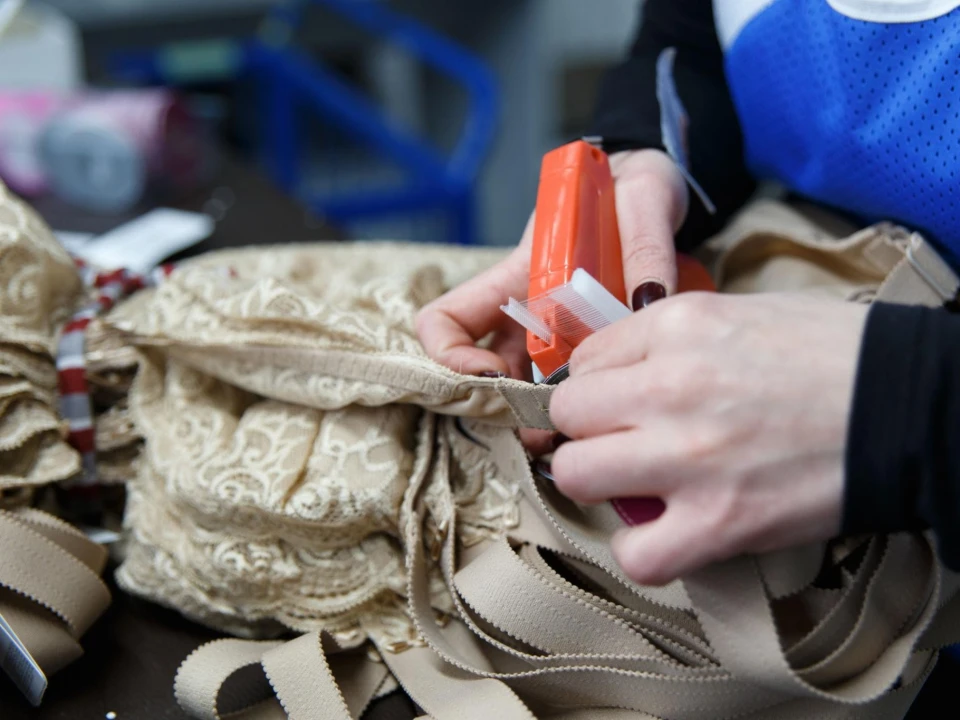

The corsetry district of Lavello, in Basilicata, stands out as one of the most unusual and unconventional industrial clusters in Italy. Unlike many districts in the North that developed from centuries-old craft traditions, this one emerged almost from scratch, transforming a small agricultural town in the Vulture-Melfese area into a specialized hub for women’s lingerie production.
Its origins are closely tied to a traumatic event: the 1980 Irpinia earthquake. Before then, Lavello had only about 33 local businesses in the textile sector, mostly small tailoring operations with no real industrial focus. In the aftermath of reconstruction, new dynamics took shape. Local cooperatives, connections with external entrepreneurs, and support from other Italian regions - especially Emilia-Romagna - helped introduce new skills and organizational models.
In the following years, this early framework expanded rapidly thanks to a combination of factors. On one hand, there was a large supply of female labor, often low-cost but highly adaptable. On the other, there was strong social cohesion and a widespread need to create stable employment in a region with limited industrial alternatives. The result was the development of a network of small and medium-sized enterprises specializing in bras, corsets, and structured lingerie.
By the late 1990s and early 2000s, the district had reached significant scale. Around 2000, production was estimated at 4-5 million garments per year, accounting for roughly 20% of Italy’s total output in the sector. These are notable figures, especially considering the small size of the area and the absence of a long-standing manufacturing tradition.
Geographically, Lavello occupies a strategic position at the intersection of Basilicata, Puglia, and Campania, in the Ofanto valley. This location has facilitated logistics and connections with other industrial areas, particularly in central and northern Italy, effectively creating a bridge between different parts of the country. The district also grew through relationships with external companies that outsourced part of their production while retaining design and commercial control.
One of its most distinctive features lies precisely in this dynamic. The Lavello corsetry district did not evolve from a historical manufacturing culture but from a process of industrial “grafting.” It demonstrates how imported expertise can quickly take root when supported by favorable social and economic conditions. In this sense, Lavello represents an atypical district model - closer to a modern construction than to an organic evolution.
Over time, local firms organized themselves into a coordinated system, supported in part by regional institutions. The Corsetry District was formally recognized as a tool to improve competitiveness, encourage innovation, and support the international expansion of local companies. The goal has been to strengthen the area’s productive identity and position it more effectively in both domestic and global markets.
From a production standpoint, the district has traditionally focused on the mid-to-low market segment, characterized by high volumes and standardized processes. However, this specialization has also led to the development of precise technical skills, particularly in working with elastic fabrics and constructing complex garments like bras, which require a high level of accuracy and craftsmanship.
Today, the district faces new challenges, including global competition and the relocation of production to countries with lower labor costs. Despite this, it remains one of the most important industrial realities in Basilicata, alongside the automotive hub of Melfi and other regional production systems.
The corsetry district of Lavello is a striking example of rapid and targeted economic transformation. Born out of crisis, it built its identity through the combination of local resources and external expertise. More than a tradition, it is the result of a strategy - an industrial system developed over just a few decades that has left a lasting impact on the local economy.