

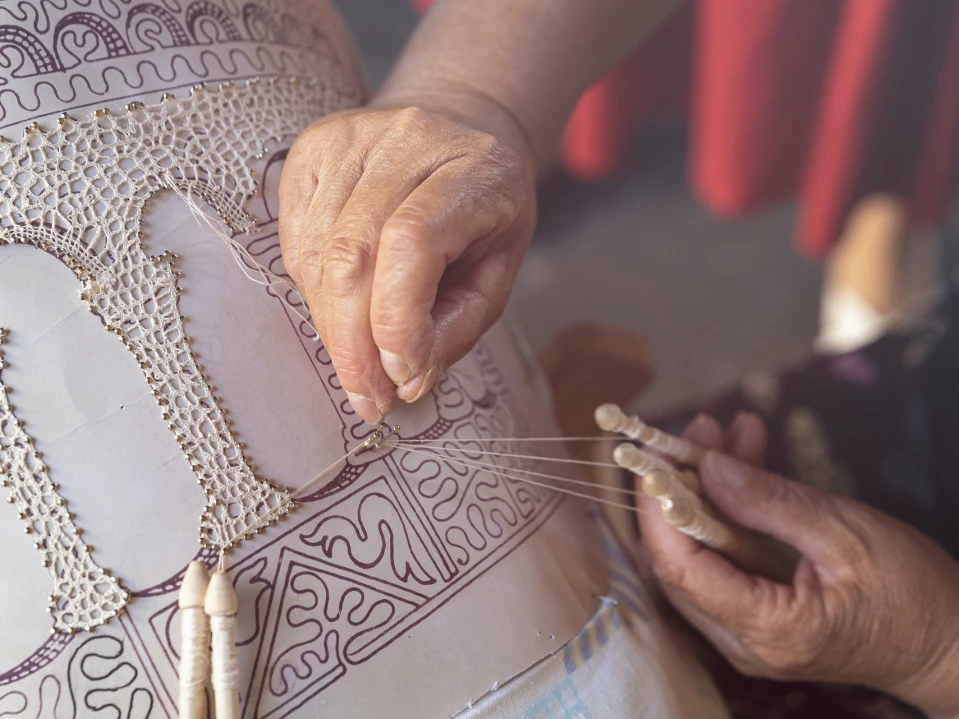

For more than 600 years, the handcrafted tradition of bobbin lace known locally as merletto a tombolo has been an enduring symbol of Italian craft heritage, particularly in the province of Isernia in Molise. This textile art, created entirely by hand, traces its roots back to the early 1400s when lacemaking began to evolve into one of Europe’s most intricate and respected crafts. Over the centuries, tombolo has continued as a living practice, carried forward by generations of lacemakers committed to preserving both technique and identity.
At its core, the craft involves weaving and twisting fine threads wound on pairs of wooden bobbins. These bobbins are worked over a padded cushion known as the tombolo, where a pattern is carefully pinned and used as a guide. With dozens of bobbins in motion, the lace grows through countless crossings, twists, and knots – each gesture requiring immense concentration and manual control. A single panel of lace, depending on its complexity and size, can involve anywhere from 4 to 100 bobbins and may take weeks or even months to complete.
Unlike mass-produced textiles, every piece of merletto a tombolo is unique. The skill of the lacemaker determines the delicacy of the design, the precision of the interwoven threads, and the harmony of motifs ranging from floral swirls to geometric lattices. Historically, this lace was used to embellish clothing, religious vestments, household linens, and ceremonial garments. In fairly recent times, it has also adorned artistic installations, public exhibitions, and festival attire, helping draw attention to the craft’s cultural value.
Throughout Molise, and especially in Isernia, the practice has long been a social as well as artisanal endeavor. In the mid-20th century, numerous artisanal workshops thrived, and women working outdoors or in communal spaces could be heard at their cushions, the gentle clacking of bobbins resonating through village streets. By the late 1900s, industrial manufacturing and changing fashions had pushed traditional lacemaking to the margins, but local proponents of the craft continued their work, determined not to let this heritage vanish.
In recent years, there has been a remarkable revival. A local association dedicated to il merletto di Isernia now counts roughly 300 members, from young apprentices in their teens to seasoned lacemakers in their 80s and 90s. Efforts include public gatherings, open-air workshops, and educational events intended to pass skills on to new generations. These activities not only protect the craft but also reinforce community identity and local pride.
Artisans here maintain that the real power of hand-made lace lies in its human origin. Each centimeter of lace embodies the patience, creativity, and fine motor skill that no machine can genuinely replicate. In an era when industrial production dominates textiles, merletto a tombolo stands as a testament to the enduring value of handcrafts – where cultural memory, personal expression, and technical mastery intersect in every delicate knot.
For Americans and others interested in traditional artisan skills, the story of merletto a tombolo di Isernia offers more than historical curiosity. It illustrates how an art form can survive centuries, adapt through crisis, and flourish again through collective effort – a lesson as relevant to communities abroad as it is to those in Molise.