
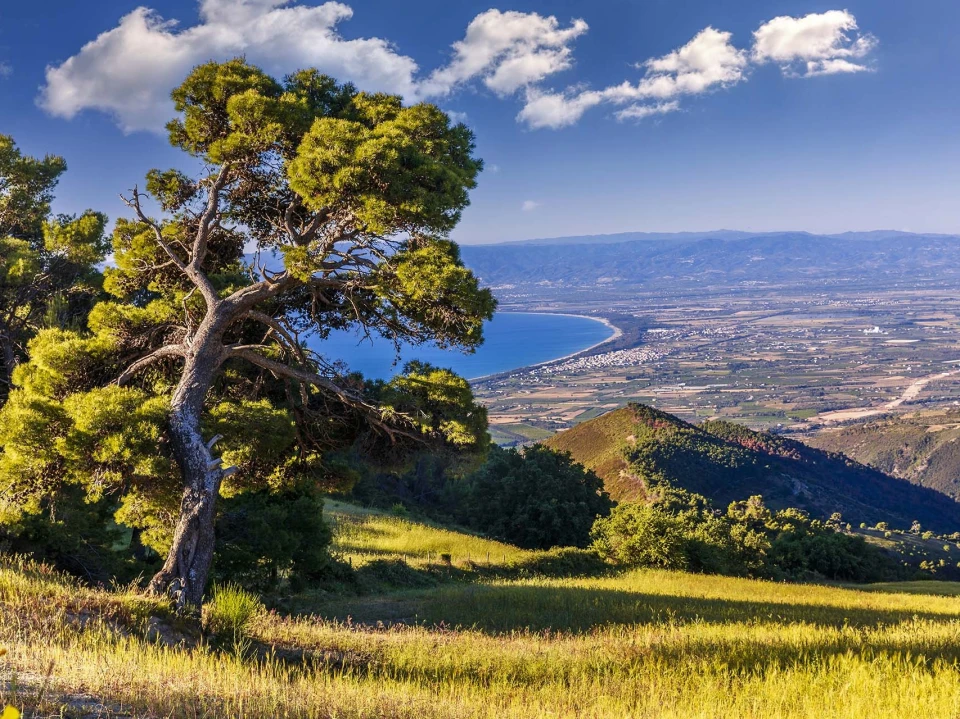

The Piana di Sibari is one of the most distinctive and historically layered territories in southern Italy, located in northern Calabria along the Ionian coast. It is the largest plain in the region, positioned between two major mountain systems – the Pollino massif to the north and the Sila plateau to the south – creating a natural corridor that connects inland Calabria with the sea.
Geographically, the plain is defined by its alluvial nature. It is crossed by the Crati River, the most important watercourse in Calabria, and its tributary Coscile, which together shape the landscape before flowing into the Ionian Sea. This network of rivers has created a fertile basin over thousands of years, making the Piana di Sibari one of the most agriculturally productive areas in southern Italy. The terrain is largely flat, a rarity in a region dominated by hills and mountains, and this physical openness has played a crucial role in its historical development and economic use.
The origins of the territory date back to prehistoric times, with archaeological evidence showing human presence as early as the Bronze and Iron Ages. However, the identity of the Piana di Sibari is deeply tied to the ancient Greek city of Sybaris, from which it takes its name. Founded around the 8th century BCE, Sybaris quickly became one of the most powerful and wealthy cities of Magna Graecia, known throughout the ancient world for its prosperity and refined lifestyle. The city’s wealth was largely due to the fertility of the surrounding plain and its strategic position along Mediterranean trade routes.
Sybaris became so famous for luxury that its name gave rise to the term “sybaritic,” still used today to describe a life of comfort and indulgence. Yet its success also made it vulnerable, and in 510 BCE the city was destroyed by its rival Croton. Despite this dramatic end, the area continued to be inhabited by successive populations, including the Enotri and the Bruzi, who relied on agriculture and pastoralism. Over time, the plain remained a vital agricultural zone, even as political control shifted through Roman, Byzantine, and later medieval powers.
One of the defining characteristics of the Piana di Sibari is its transformation in the modern era. Historically, much of the area was marshy and unhealthy, limiting settlement and development. It was only in the 20th century, particularly during the land reclamation projects of the 1930s, that the territory was drained and made fully cultivable. This process marked a turning point, attracting populations from nearby mountainous areas and laying the foundation for a modern agricultural economy.
Today, agriculture remains central to the identity of the plain. The region is known for its production of citrus fruits, olives, and even rice – a rare crop in southern Italy, made possible by the abundance of water and flat terrain. These agricultural practices reflect both the natural fertility of the land and a long tradition of working the soil, connecting contemporary life to ancient patterns of cultivation.
The territory also includes a network of towns such as Corigliano-Rossano, Cassano all’Ionio, and Castrovillari, which serve as economic and cultural centers. Near Cassano lies the archaeological park of Sibari, where the remains of ancient cities – Sybaris, Thurii, and Copia – offer tangible evidence of the area’s historical importance. These layers of history coexist within a landscape that is both natural and cultivated, where ancient ruins stand alongside modern farms.
What makes the Piana di Sibari truly unique is this combination of geography, history, and transformation. It is a place where natural conditions have consistently shaped human activity, from ancient Greek colonization to modern agricultural development. The coexistence of fertile land, strategic location, and deep historical roots gives the plain a strong and recognizable identity.
In essence, the Piana di Sibari is not just a geographic area but a living landscape. It tells a story of continuity and change – from one of the richest cities of the ancient world to a modern agricultural hub – while maintaining a clear connection between its past and present.