
It may seem unusual, but there are moments in history when a glass of wine tells us more than a diplomatic treaty. And perhaps especially today, at a time when international relations once again seem to be measured primarily through the language of power – military, economic, or technological – it is worth remembering that nations have often built their influence through far subtler and, at times, more enduring instruments.
Culture, landscape, ideas, taste, and the ability to embody and transmit a model of civilization have exercised a form of power throughout history that is quiet yet profound. Unlike armies and conquests, this power leaves lasting traces not by imposing itself, but by attracting; not by coercing, but by inspiring admiration and curiosity.
Today we call this soft power. Yet long before the term entered the vocabulary of international relations, it was already at work. One of its most fascinating expressions can be found among the hills of Montepulciano and in the wine produced there.
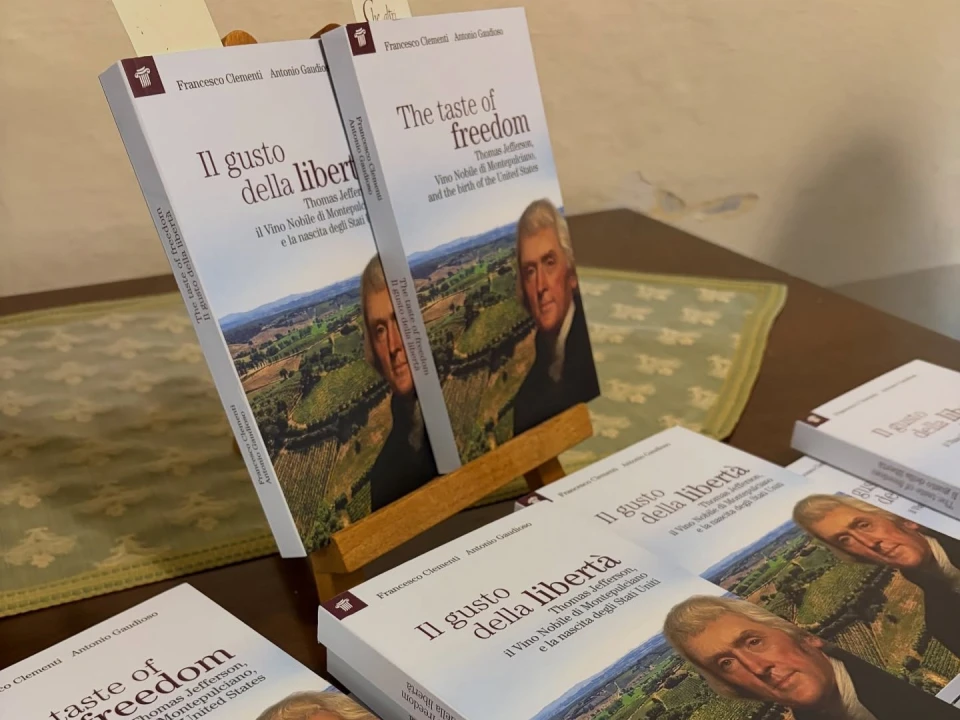
The story is worth telling, especially because in 2026 the United States celebrates the 250th anniversary of the Declaration of Independence, the document that not only marked the birth of a new nation but also offered the world one of modern history’s most powerful ideas: the right to life, liberty, and the pursuit of happiness. Those words bear the signature of Thomas Jefferson, perhaps the most European-minded of America’s Founding Fathers.
When Jefferson arrived in the Old World as a representative of the young Republic, he did not limit himself to observing governments, parliaments, and institutions. He sought to understand why some societies had succeeded better than others in generating prosperity, freedom, culture, and stability. He studied rural landscapes, agricultural systems, commerce, manufacturing, and ways of life, examining the relationship between a territory and the communities that inhabit it, between material wealth and the quality of civic life.
There is something in this approach that recalls the method later associated with Camillo Benso di Cavour. Like Jefferson, Cavour looked beyond the boundaries of his own political reality, viewing the United Kingdom as the most advanced laboratory of European modernity. He studied its mechanisms in order to learn from them without sacrificing his own identity.
Jefferson undertook a similar exercise with regard to Europe. He did not view the continent through the eyes of a traveler captivated by the exotic, but through those of a scholar searching for the deeper conditions that make a free society possible.
It was within this context that his interest in Vino Nobile di Montepulciano emerged. At first glance, it may seem like little more than an oenological curiosity. In reality, it was much more. Jefferson was, above all, an observer of civilizations, and behind every product of excellence he searched for the system of values that had made it possible.
For this reason, when he praised the quality of Tuscan wines and continued to favor Montepulciano even when less expensive alternatives were suggested, he was not simply expressing a personal preference. He was recognizing a reputation, the value of a community, and the success of a territory that, through hard work, accumulated knowledge, and the continuity of traditions, had transformed an agricultural product into a cultural symbol.
In other words, Jefferson recognized in Vino Nobile di Montepulciano a fragment of Europe at its best: a Europe capable of generating prosperity without abandoning beauty, preserving memory without rejecting innovation, and building identity without closing itself off from the world.
This is where wine becomes an extraordinary form of soft power before the term even existed. A great wine is never merely a commodity. It is a story that crosses borders, a landscape that travels, a community presenting itself to the world without the need for proclamations. It is tangible proof that quality can become reputation and that reputation can become influence.
Through Jefferson’s choices, Vino Nobile di Montepulciano crossed the Atlantic and helped shape, in the imagination of the young United States, an image of Tuscany understood not simply as a geographic location but as the expression of a particular vision of civilization – one capable of making desirable a way of life founded on the balance between freedom, responsibility, and beauty.
For this reason, the connection between Jefferson and Montepulciano remains surprisingly relevant today. It reminds us that in an age dominated by speed, polarization, and simplification, wine – when it is an authentic expression of a territory’s culture and a community’s history – possesses its own political and civic power.
Great democracies, after all, do not live by procedures, laws, and institutions alone. They also depend on shared symbols, recognized identities, and cultural heritage capable of generating belonging and respect.
Ultimately, this is where soft power begins: in the ability to transform quality into reputation, history into narrative, territory into identity, and beauty into connection. Sometimes it can even begin with a glass of wine. Because, as Jefferson understood two and a half centuries ago, the finest products of the land do not merely tell us who we are; they tell us, above all, who we aspire to become.