In 2026, We the Italians celebrates “Two Anniversaries, One Heart” – the 250th anniversary of the United States and the 80th anniversary of the Italian Republic. This article is part of the “Happy Birthday USA: Italy’s Role in America’s Greatness” project, in which we tell the stories of 18 well-known figures of Italian heritage who helped make the United States great.
---
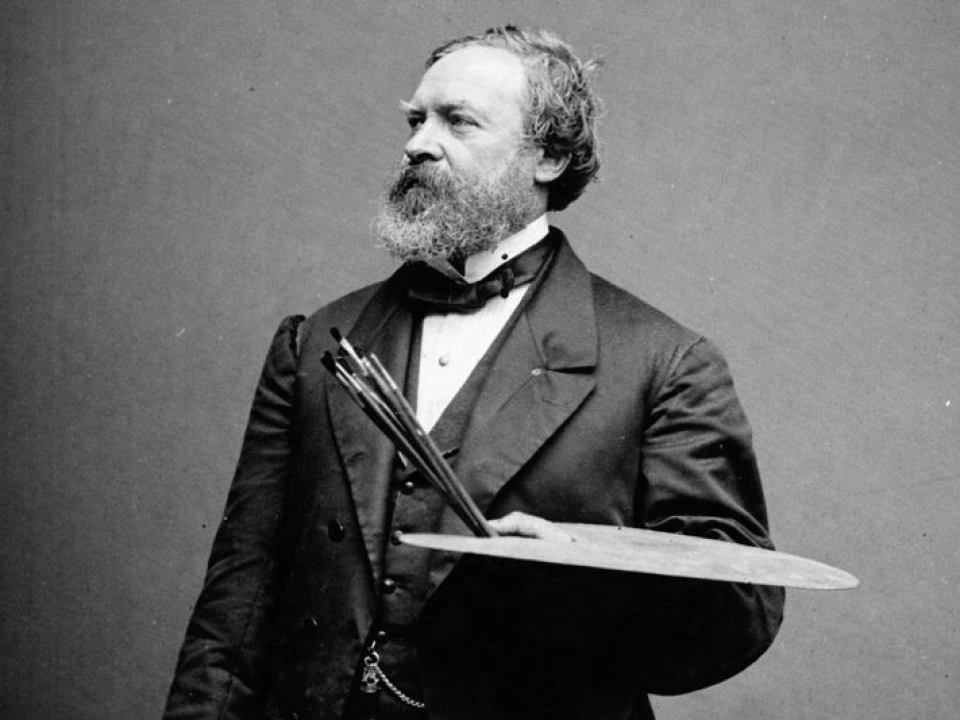
Costantino Brumidi, a Roman beneath the dome of America
When one enters the United States Capitol and looks up toward the great dome, one unknowingly performs a profoundly Roman gesture. Because up there, in the symbolic heart of American democracy, lives the work of Costantino Brumidi - an artist born in Rome in 1805, trained in the workshops and academies of the papal city, and who arrived in the United States as a political émigré even before becoming a celebrated painter. His signature, invisible to most, is nonetheless imprinted on the very construction of the American national imagination.
Brumidi is important to the history of the United States because he played a decisive role in giving visual form to the nation’s founding myth. His pictorial cycles in the Capitol - first and foremost the *Apotheosis of Washington* (1865) in the dome - translate into an allegorical and monumental language the idea of a republic destined to endure, to rise, to tell its own story as a new civilization. This is not mere decoration; it is political narration through images. In a young country, lacking a long monumental tradition, Brumidi brought the grammar of Roman fresco, Baroque theatricality, and the symbolic use of figures, adapting them to a new secular pantheon made up of Founding Fathers, science, progress, and civic virtues.
In this sense, Brumidi is an integral part of the process of constructing American identity - an identity that, paradoxically, is consolidated also through the gaze and the hand of a European. The Capitol thus becomes not only the seat of legislative power, but a space for representing the nation, a place where art and politics merge explicitly, following a tradition that in Europe - and in Rome in particular - had been established for centuries.
But what makes Brumidi even more interesting today is not only what he did, but how he did it and where he came from. Brumidi was no ordinary artist: he had worked in the Vatican, knew the papal building sites, had restored Raphael, and moved within a culture of the highest figurative refinement. Yet, for political reasons tied to the Risorgimento uprisings and the repressive climate of papal Rome, he was forced to leave Italy. In the United States he began almost from scratch, facing distrust, precariousness, and uncertain commissions. Only after years of work was he recognized as the right man to decorate the institutional heart of the country.
Personally, Brumidi strikes me not only as an artist, but as a human figure: a professional of the highest level who crossed the ocean carrying with him ancient knowledge, adapting it to a completely new context without ever disavowing his training. Ultimately, it is a story of intellectual and cultural migration, not merely economic migration. And at a time when migration is often described only as an emergency or a problem, Brumidi reminds us how great movements of people are also movements of ideas, techniques, languages, and worldviews.
For us Italians - and for us Romans in particular - Brumidi is a kind of silent ambassador of our artistic tradition. His work in the United States shows how the Roman school of fresco, the ability to construct complex narrative spaces, and mastery of figure and allegory played a direct role in shaping American public aesthetics. This is not just a matter of stylistic influence; it is the transfer of a way of conceiving art as a civic instrument, as an integral part of institutional architecture, as a vehicle for collective values.
From the perspective of Italy’s cultural sector, Brumidi represents an exemplary case of ante litteram “soft power”: without cultural policies, without promotional institutes, without diplomatic strategies, it is the very quality of Italian artistic training that asserts itself as a model. Rome, with its academies, its workshops, its building sites, thus becomes indirectly part of the process of symbolic construction of the United States. It is a relationship that today should be told much more, especially in educational and museum pathways, because it helps us understand how art history is also a history of international relations, exchanges, and hybridizations.
There is also another aspect that, as an administrator and an art historian, I feel particularly close to: Brumidi worked on public commission, for a public space, for a public function. He did not produce works destined for the private market or for pure individual celebration, but contributed to building a place that symbolically belongs to all American citizens. It is a profoundly civic idea of art that today, even in Italy, we might need to reclaim with greater courage: art not only as an event, but as cultural infrastructure, as part of the urban and institutional landscape.
Ultimately, Costantino Brumidi is important to the United States because he helped give a face and an image to their nascent democracy; he is important to Italy because he demonstrates how deeply our artistic tradition has concretely shaped the construction of the modern Western imagination; and he is important to us Romans because he tells the story of a Rome that is not only a museum-city, but a forge of skills, crafts, and intelligences capable of leaving a mark on the world.
Under the Capitol dome, between Washington transformed into an almost mythological figure and the personifications of civic virtues, a piece of Rome still lives today. And perhaps, in times of fragile identities and shouted borders, remembering that part of American history was painted by a Roman in exile can help us read history with a more complex, more truthful - and also more just - gaze.
Nel 2026 We the Italians celebra Two Anniversaries One Heart, i 250 anni degli Stati Uniti e gli 80 anni della Repubblica Italiana. Questo articolo fa parte del progetto Happy Birthday USA: Italy’s role in America’s greatness, in cui raccontiamo 18 famosi personaggi di origine italiana che hanno fatto grandi gli Stati Uniti.
---
Costantino Brumidi, un romano sotto la cupola dell’America
Quando si entra nel Campidoglio degli Stati Uniti e si alza lo sguardo verso la grande cupola, si compie senza saperlo un gesto profondamente romano. Perché lassù, nel cuore simbolico della democrazia americana, vive l’opera di Costantino Brumidi, artista nato a Roma nel 1805, formatosi nelle botteghe e nelle accademie della città pontificia, e approdato negli Stati Uniti come emigrato politico, prima ancora che come pittore celebrato. La sua firma, invisibile ai più, è invece impressa nella costruzione stessa dell’immaginario nazionale americano.
Brumidi è importante per la storia degli Stati Uniti perché ha contribuito, in modo determinante, a dare forma visiva al mito fondativo della nazione. I suoi cicli pittorici nel Capitol — primo fra tutti l’“Apoteosi di Washington” (1865) nella cupola — traducono in linguaggio allegorico e monumentale l’idea di una repubblica destinata a durare, a elevarsi, a raccontarsi come nuova civiltà. Non è solo decorazione: è narrazione politica per immagini. In un paese giovane, privo di una lunga tradizione monumentale, Brumidi porta la grammatica dell’affresco romano, la teatralità barocca, l’uso simbolico delle figure, adattandoli a un nuovo pantheon laico fatto di padri fondatori, scienza, progresso, virtù civiche.
In questo senso, Brumidi è parte integrante del processo di costruzione dell’identità americana: un’identità che, paradossalmente, si consolida anche grazie allo sguardo e alla mano di un europeo. Il Campidoglio diventa così non solo sede del potere legislativo, ma spazio di rappresentazione della nazione, un luogo dove arte e politica si fondono in modo esplicito, secondo una tradizione che in Europa — e a Roma in particolare — era consolidata da secoli.
Ma ciò che rende Brumidi ancora più interessante, oggi, non è solo ciò che ha fatto, bensì come lo ha fatto e da dove veniva. Brumidi non era un artista qualsiasi: aveva lavorato in Vaticano, conosceva i cantieri pontifici, aveva restaurato Raffaello, si muoveva dentro una cultura figurativa altissima. Eppure, per ragioni politiche legate ai moti risorgimentali e al clima repressivo della Roma pontificia, fu costretto a lasciare l’Italia. Negli Stati Uniti ricomincia quasi da zero, affrontando diffidenza, precarietà, committenze incerte. Solo dopo anni di lavoro viene riconosciuto come l’uomo giusto per decorare il cuore istituzionale del paese.
Qui, personalmente, Brumidi mi colpisce non solo come artista, ma come figura umana: un professionista di altissimo livello che attraversa l’oceano portando con sé un sapere antico, adattandolo a un contesto completamente nuovo, senza mai rinnegare la propria formazione. In fondo, è una storia di migrazione intellettuale e culturale, non solo economica. E in tempi in cui la migrazione viene spesso raccontata solo come emergenza o problema, Brumidi ci ricorda quanto i grandi passaggi di persone siano anche passaggi di idee, tecniche, linguaggi, visioni del mondo.
Per noi italiani — e per noi romani in particolare — Brumidi è una sorta di ambasciatore silenzioso della nostra tradizione artistica. La sua opera negli Stati Uniti dimostra come la scuola romana dell’affresco, la capacità di costruire spazi narrativi complessi, la padronanza della figura e dell’allegoria abbiano avuto un ruolo diretto nella formazione dell’estetica pubblica americana. Non si tratta solo di influenza stilistica: si tratta di trasferimento di un modo di concepire l’arte come strumento civico, come parte integrante dell’architettura istituzionale, come veicolo di valori collettivi.
Dal punto di vista del settore culturale italiano, Brumidi rappresenta un caso esemplare di “soft power” ante litteram: senza politiche culturali, senza istituti di promozione, senza strategie diplomatiche, è la qualità stessa della formazione artistica italiana a imporsi come modello. Roma, con le sue accademie, le sue botteghe, i suoi cantieri, diventa indirettamente parte del processo di costruzione simbolica degli Stati Uniti. È una relazione che oggi andrebbe raccontata molto di più, soprattutto nei percorsi educativi e museali, perché aiuta a comprendere quanto la storia dell’arte sia anche storia di relazioni internazionali, di scambi, di ibridazioni.
C’è poi un altro aspetto che, da amministratrice e da storica dell’arte, sento particolarmente vicino: Brumidi lavora su commissione pubblica, per uno spazio pubblico, per una funzione pubblica. Non produce opere destinate al mercato privato o alla pura celebrazione individuale, ma contribuisce a costruire un luogo che appartiene simbolicamente a tutti i cittadini americani. È un’idea di arte profondamente civica, che oggi, anche in Italia, dovremmo forse recuperare con più coraggio: arte non solo come evento, ma come infrastruttura culturale, come parte del paesaggio urbano e istituzionale.
In definitiva, Costantino Brumidi è importante per gli Stati Uniti perché ha contribuito a dare volto e immagine alla loro democrazia nascente; è importante per l’Italia perché dimostra quanto la nostra tradizione artistica abbia inciso, concretamente, nella costruzione dell’immaginario occidentale moderno; ed è importante per noi romani perché racconta una Roma che non è solo città-museo, ma fucina di competenze, di maestranze, di intelligenze capaci di lasciare un segno nel mondo.
Sotto la cupola del Capitol, tra Washington trasformato in figura quasi mitologica e le personificazioni delle virtù civiche, vive ancora oggi un pezzo di Roma. E forse, in tempi di identità fragili e confini urlati, ricordare che una parte della storia americana è stata dipinta da un romano in esilio può aiutarci a leggere la storia con uno sguardo più complesso, più vero, e anche più giusto.