In 2026, We the Italians celebrates “Two Anniversaries, One Heart” – the 250th anniversary of the United States and the 80th anniversary of the Italian Republic. This article is part of the “Happy Birthday USA: Italy’s Role in America’s Greatness” project, in which we tell the stories of 18 well-known figures of Italian heritage who helped make the United States great.
---
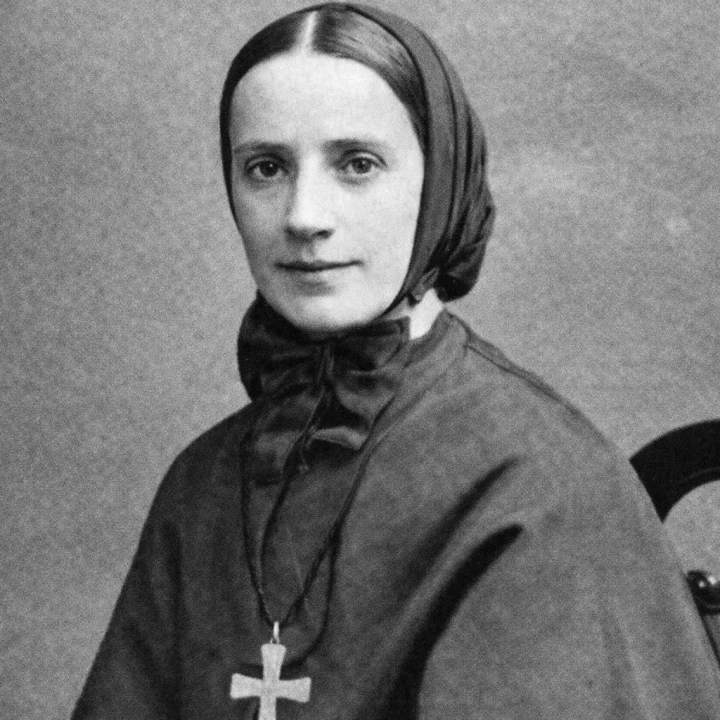
Francesca Cabrini An Italian and American story of migration, faith, and courage
Francesca Saverio Cabrini was born in Sant’Angelo Lodigiano in 1850, into a deeply Catholic family. From a young age she showed a strong religious vocation, despite fragile health that would accompany her throughout her life. After earning her teaching diploma, she entered a religious community in 1874 and in 1880 founded in Codogno the Institute of the Missionary Sisters of the Sacred Heart of Jesus, which would become one of the principal instruments of her charitable work.
The decisive moment of her life came with her decision to leave for the United States, where Italian emigration was reaching enormous numbers. Between 1880 and 1920, more than four million Italians crossed the Atlantic, often in conditions of extreme poverty. When Cabrini arrived in New York in 1889, she found communities marked by unemployment, disease, illiteracy, and cultural isolation. Her response was not only spiritual but above all concrete and organizational.
Within a few years she founded elementary schools, kindergartens, girls’ academies, orphanages, shelters, and hospitals. One of her most significant works was Columbus Hospital in New York. Thanks to fundraising and the work of the sisters, the facility expanded rapidly and exceeded 150 beds by 1905, becoming a point of reference for Italian immigrants, who could finally receive medical care in a language they understood and in an environment that respected their dignity.
Cabrini understood that integration also depended on education. The schools founded by the Missionary Sisters of the Sacred Heart offered literacy, English instruction, and vocational training. In many urban areas of the United States, these institutions represented the only alternative to the streets for children and young people from migrant families.
At her death in 1917 in Chicago, the institutions she had created numbered 67 and the sisters engaged in the missions were about 1,300. In 1909 she obtained United States citizenship, further strengthening her bond with the country she had chosen as her principal field of action.
Francesca Cabrini’s importance for the United States lies in her ability to transform charity into an organized system of social assistance, anticipating models of welfare that would only emerge decades later. Her works concretely improved the lives of thousands of people and helped change the perception of Italian immigrants.
On July 7, 1946, she was proclaimed a saint, becoming the first American saint in history.
Interpreting the role of Francesca Cabrini had an impact on me that goes far beyond the work of an actress. It was not merely a character to study, an accent to modulate, or an era to reconstruct: it was a profound encounter with a conscience, with a vision of the world, and with a collective wound that spans centuries. Telling her story meant passing through the pain and hope of millions of people, yesterday as today.
Francesca Cabrini was a woman capable of transforming her own fragility into a revolutionary strength. A migrant among migrants, a foreigner in a foreign land, who chose to stand with the least without rhetoric, but with concrete actions. Studying her life, I felt a responsibility growing within me: to convey not only her determination, but also her humanity, her fears, her stubborn faith, her quiet courage. I did not want to portray an icon, but a living, complex woman, capable of doubt and yet able to move forward.
What struck me most was the universal dimension of her story. Emigration is not a marginal chapter of human history: it is human history itself. All peoples, at some point in their existence, have been migrants. People leave because of hunger, war, dreams, love, necessity, or vision. They leave with a light suitcase and a heavy heart. They leave behind a language, a landscape, the scent of home. Interpreting Cabrini meant touching this condition of uprootedness and, at the same time, of rebirth.
I felt a strong pride in telling a piece of history that belongs not only to a religious community or a nation, but to all humanity. Because the migratory experience is transversal, crossing continents, cultures, and eras. It is an invisible thread that binds distant generations together. Telling this story today also means questioning the present: how we look at those who arrive, and how capable we are of recognizing in others a part of ourselves.
Cabrini did not see “foreigners”: she saw people. And this gaze, so simple and so revolutionary, profoundly transformed me. In portraying her, I learned that identity is not a closed fortress, but a house with open doors. I understood that true strength lies not in defending a border, but in building bridges. And that dignity is not a privilege, but a universal right.
As a Neapolitan woman, this role had for me an even more intimate meaning. Naples is a city that carries mixture in its DNA. It is a city that over the centuries has been crossed by different peoples: Greeks, Romans, Spaniards, French, Arabs. It is a crossroads of cultures, a land of departures and returns. By definition, Neapolitans are a people of migrants. We have crossed oceans, built communities far away, carried with us a language, a music, a way of being in the world. But at the same time we are a people who welcome. Naples is multicultural by vocation, open to the foreigner not by strategy, but by nature.
Growing up in such a city means learning early that identity is plural. That the other is not a threat, but a possibility. When I stepped into Cabrini’s shoes, I felt there was a direct thread between her mission and my own belonging. Telling the story of Italian emigrants in America was not only a historical exercise: it was telling a part of my own collective memory. The faces of those migrants resembled faces I have known, stories heard within my family, departures that marked entire generations.
Interpreting this role also forced me to confront the privilege of the storyteller. Bringing such a delicate story to the stage means choosing every gesture and every silence with care. It means avoiding rhetoric and seeking truth. I worked to find a balance between the public strength of the missionary and the private vulnerability of the woman. Because I believe it is precisely in that vulnerability that her greatness lies.
Cabrini taught me that courage is not the absence of fear, but the decision not to be ruled by fear. She taught me that faith, in whatever form it takes, is also a radical trust in humanity. And she taught me that stories of migration are not only stories of loss, but also of transformation.
Bringing this story to the public made me feel part of something greater than my individual path. As an actress, one often questions the meaning of one’s work. In this case, the meaning was crystal clear: to give voice to those who were invisible, to remember that behind every number there is a name, a face, a mother, a son. I felt that I was not merely playing a role, but helping to keep a necessary memory alive.
And in a time when the issue of emigration is often instrumentalized, simplified, reduced to slogans, telling the story of a woman who chose to stand beside migrants with concrete dedication was almost a political act in the highest sense of the term: an act of civic responsibility.
I am proud to have told this universal piece of history. Proud to have embodied a woman who crossed the ocean not in search of personal fortune, but to bring care. Proud, as a Neapolitan, to have given voice to a story that speaks of departures and arrivals, of nostalgia and hope, of identities that transform without being lost.
Portraying Francesca Cabrini changed me. It made me more aware of my roots and more open to the world. It reminded me that every human being, ultimately, is the child of a migration. And that recognizing this truth means recognizing the other as part of the same great human story.
Nel 2026 We the Italians celebra Two Anniversaries One Heart, i 250 anni degli Stati Uniti e gli 80 anni della Repubblica Italiana. Questo articolo fa parte del progetto Happy Birthday USA: Italy’s role in America’s greatness, in cui raccontiamo 18 famosi personaggi di origine italiana che hanno fatto grandi gli Stati Uniti.
---
Francesca Cabrini Una storia italiana e americana di migrazione, fede e coraggio
Francesca Saverio Cabrini nacque a Sant’Angelo Lodigiano nel 1850, in una famiglia profondamente cattolica. Fin da giovane manifestò una forte vocazione religiosa, nonostante una salute fragile che avrebbe accompagnato tutta la sua vita. Dopo aver conseguito il diploma magistrale, nel 1874 entrò in una comunità religiosa e nel 1880 fondò a Codogno l’istituto delle Missionarie del Sacro Cuore di Gesù, destinato a diventare uno dei principali strumenti della sua azione caritativa.
Il momento decisivo della sua vita avvenne con la scelta di partire per gli Stati Uniti, dove l’emigrazione italiana stava raggiungendo numeri enormi. Tra il 1880 e il 1920 oltre 4 milioni di italiani attraversarono l’Atlantico, spesso in condizioni di estrema povertà. Quando Cabrini arrivò a New York nel 1889, trovò comunità segnate da disoccupazione, malattie, analfabetismo e isolamento culturale. La sua risposta non fu solo spirituale ma soprattutto concreta e organizzativa.
In pochi anni fondò scuole elementari, asili, collegi femminili, orfanotrofi, case di accoglienza e ospedali. Una delle sue opere più significative fu il Columbus Hospital di New York. Grazie alla raccolta di fondi e al lavoro delle religiose, la struttura si ampliò rapidamente e superò i 150 posti entro il 1905, diventando un punto di riferimento per gli immigrati italiani, che finalmente potevano ricevere cure mediche in una lingua comprensibile e in un contesto rispettoso della loro dignità.
Cabrini comprese che l’integrazione passava anche dall’istruzione. Le scuole fondate dalle Missionarie del Sacro Cuore offrivano alfabetizzazione, insegnamento dell’inglese e formazione professionale. In molte aree urbane degli Stati Uniti, queste istituzioni rappresentavano l’unica alternativa alla strada per bambini e ragazzi provenienti da famiglie migranti.
Alla sua morte, avvenuta nel 1917 a Chicago, le strutture create erano 67 e le religiose impegnate nelle missioni circa 1.300. Nel 1909 ottenne la cittadinanza statunitense, rafforzando ulteriormente il suo legame con il paese che aveva scelto come principale campo d’azione.
L’importanza di Francesca Cabrini per gli Stati Uniti risiede nella capacità di trasformare la carità in un sistema organizzato di assistenza sociale, anticipando modelli di welfare che si sarebbero affermati solo decenni dopo. Le sue opere migliorarono concretamente la vita di migliaia di persone e contribuirono a cambiare la percezione degli immigrati italiani.
Il 7 luglio 1946 fu proclamata santa, diventando la prima santa americana della storia.
Interpretare il ruolo di Francesca Cabrini ha avuto su di me un impatto che va ben oltre il lavoro dell’attrice. Non è stato soltanto un personaggio da studiare, un accento da modulare o un’epoca da ricostruire: è stato un incontro profondo con una coscienza, con una visione del mondo e con una ferita collettiva che attraversa i secoli. Raccontare la sua storia ha significato attraversare il dolore e la speranza di milioni di persone, ieri come oggi.
Francesca Cabrini è stata una donna capace di trasformare la propria fragilità in una forza rivoluzionaria. Una migrante tra i migranti, una straniera in terra straniera, che ha scelto di stare dalla parte degli ultimi senza retorica, ma con azioni concrete. Studiando la sua vita, ho sentito crescere dentro di me una responsabilità: quella di restituire non solo la sua determinazione, ma anche la sua umanità, le sue paure, la sua fede ostinata, il suo coraggio silenzioso. Non volevo interpretare un’icona, ma una donna viva, complessa, capace di dubitare eppure di andare avanti.
Quello che più mi ha colpita è stata la dimensione universale della sua storia. L’emigrazione non è un capitolo marginale della storia umana: è la storia umana stessa. Tutti i popoli, in un momento della loro esistenza, sono stati migranti. Si parte per fame, per guerra, per sogno, per amore, per necessità o per visione. Si parte con una valigia leggera e un cuore pesante. Si parte lasciando indietro una lingua, un paesaggio, un odore di casa. Interpretare Cabrini ha significato toccare con mano questa condizione di sradicamento e, allo stesso tempo, di rinascita.
Ho sentito forte l’orgoglio di raccontare un pezzo di storia che non appartiene solo a una comunità religiosa o a una nazione, ma all’umanità intera. Perché l’esperienza migratoria è trasversale, attraversa continenti, culture, epoche. È un filo invisibile che lega generazioni lontane tra loro. Raccontare questa storia oggi significa anche interrogarsi sul presente: su come guardiamo chi arriva, su quanto siamo capaci di riconoscere nell’altro una parte di noi stessi.
Cabrini non vedeva “stranieri”: vedeva persone. E questo sguardo, così semplice e così rivoluzionario, mi ha profondamente trasformata. Interpretandola, ho imparato che l’identità non è una fortezza chiusa, ma una casa con le porte aperte. Ho compreso che la vera forza non sta nel difendere un confine, ma nel costruire ponti. E che la dignità non è un privilegio, ma un diritto universale.
Da napoletana, questo ruolo ha avuto per me un significato ancora più intimo. Napoli è una città che porta nel proprio DNA la mescolanza. È una città che nei secoli è stata attraversata da popoli diversi: greci, romani, spagnoli, francesi, arabi. È un crocevia di culture, una terra di partenze e di ritorni. Per definizione, i napoletani sono un popolo di migranti. Abbiamo attraversato oceani, costruito comunità lontane, portato con noi una lingua, una musica, un modo di stare al mondo. Ma allo stesso tempo siamo un popolo che accoglie. Napoli è multiculturale per vocazione, aperta allo straniero non per strategia, ma per natura.
Crescere in una città così significa imparare presto che l’identità è plurale. Che l’altro non è una minaccia, ma una possibilità. Quando ho indossato i panni di Cabrini, ho sentito che c’era un filo diretto tra la sua missione e la mia appartenenza. Raccontare gli emigranti italiani in America non era solo un esercizio storico: era raccontare una parte della mia stessa memoria collettiva. I volti di quei migranti avevano qualcosa dei volti che ho conosciuto, delle storie sentite raccontare in famiglia, delle partenze che hanno segnato intere generazioni.
Interpretare questo ruolo mi ha anche costretta a confrontarmi con il privilegio di chi racconta. Portare in scena una storia così delicata significa scegliere con cura ogni gesto, ogni silenzio. Significa evitare la retorica e cercare la verità. Ho lavorato per trovare un equilibrio tra la forza pubblica della missionaria e la vulnerabilità privata della donna. Perché credo che sia proprio in quella vulnerabilità che si nasconda la sua grandezza.
Cabrini mi ha insegnato che il coraggio non è assenza di paura, ma decisione di non lasciarsi governare dalla paura. Mi ha insegnato che la fede, qualunque forma essa prenda, è anche una fiducia radicale nell’umanità. E mi ha insegnato che le storie che parlano di migrazione non sono storie di perdita soltanto, ma anche di trasformazione.
Portare questa storia al pubblico mi ha fatto sentire parte di qualcosa di più grande del mio percorso individuale. Come attrice, spesso ci si interroga sul senso del proprio lavoro. In questo caso, il senso era chiarissimo: dare voce a chi è stato invisibile, ricordare che dietro ogni numero c’è un nome, un volto, una madre, un figlio. Sentivo che non stavo soltanto interpretando un ruolo, ma contribuendo a tenere viva una memoria necessaria.
E in un tempo in cui il tema dell’emigrazione è spesso strumentalizzato, semplificato, ridotto a slogan, raccontare la storia di una donna che ha scelto di stare accanto ai migranti con dedizione concreta è stato un atto quasi politico nel senso più alto del termine: un atto di responsabilità civile.
Sono orgogliosa di aver raccontato questo pezzo di storia universale. Orgogliosa di aver incarnato una donna che ha attraversato l’oceano non per cercare fortuna personale, ma per portare cura. Orgogliosa, da napoletana, di aver dato voce a una vicenda che parla di partenze e di approdi, di nostalgia e di speranza, di identità che si trasformano senza perdersi.
Interpretare Francesca Cabrini mi ha cambiata. Mi ha reso più consapevole delle mie radici e più aperta al mondo. Mi ha ricordato che ogni essere umano, in fondo, è figlio di una migrazione. E che riconoscere questa verità significa riconoscere l’altro come parte della stessa, grande, storia umana.