

The glass district of Vasto–San Salvo is one of Italy’s most significant industrial centers for flat glass production, with a strong focus on automotive and construction applications. Located in southern Abruzzo, the district has shaped the economic identity of the Vastese area for decades and continues to play a strategic role in national manufacturing as it moves into 2026.
The modern industrial phase began on May 23, 1962, with the founding of Società Italiana Vetro, known as SIV. The company was created under the leadership of Enrico Mattei, who transformed a local limitation into an opportunity. A methane deposit discovered in Abruzzo was unsuitable for domestic consumption, but it proved ideal for fueling glass furnaces. This decision allowed large-scale production to take root locally. Within a few years, SIV became Europe’s second-largest producer of automotive glass, capturing a market share of 22%. The arrival of heavy industry sparked rapid industrialization, generating jobs, improving living standards, and reshaping the social fabric of the southern Abruzzo coastline.
Behind this modern success lies a much older story. Glassmaking in the Vasto area dates back several centuries. By the end of the 17th century, two glassworks were active in Vasto, confirming the town’s early role in the sector. Murano glassmakers had been present in the area as early as the 14th century, but written evidence becomes clearer later on. A document dated 1671 records shipments of glass panes from Vasto to Naples, along with mirrors and thousands of individual sheets, suggesting an already well-organized workshop capable of sustained production and trade.
The most prominent early factory was founded in 1694 by Lorenzo Del Moro, a Murano glassmaker who established his operation with the backing of the Marquis of Vasto. For nearly nine years, the glassworks contributed to local employment and craftsmanship. In 1702, however, a fire destroyed the facility, bringing this first industrial chapter to an abrupt end. Despite the closure, glassmaking knowledge did not disappear. Techniques survived through local artisans, laying a cultural foundation that would resurface centuries later.
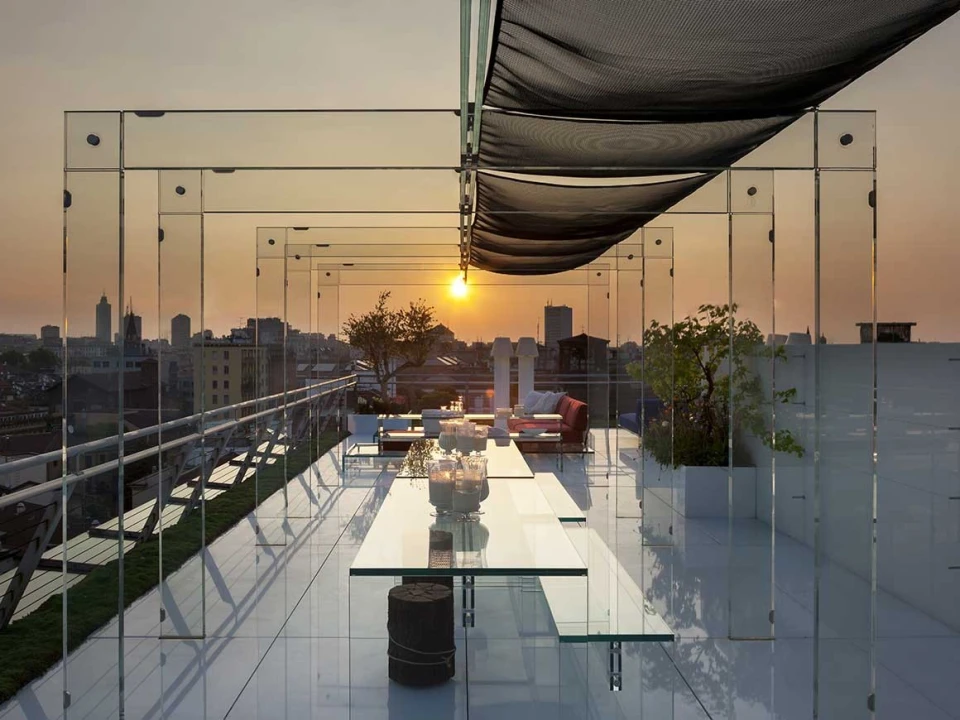
Today, the district is concentrated around San Salvo, alongside Gissi and Atessa, within the province of Chieti. The area includes 15 municipalities and hosts a dense network of small and medium-sized enterprises working alongside major industrial plants. These companies specialize in transparent and white flat glass, as well as decorative and architectural products such as panels, doors, tabletops, lighting elements, and mosaics. While not a historic district like Murano, the Vastese cluster is considered modern, adaptive, and technologically advanced.
In the 1990s, SIV was acquired by Pilkington, later incorporated into the Japanese NSG Group in 2006. The San Salvo plant now employs more than 2,000 workers, with a similar number active in the supply chain. Current production stands at 140,000 tons of flat glass per year.
Planned investments for 2026 include a new float glass furnace that will raise output to 160,000 tons annually, an increase of 14%. The upgrade will also expand production into architectural and design glass. Energy efficiency is central to the project, with expected savings of 3.5 million cubic meters of gas and 260,000 cubic meters of water per year. Designed to support future hydrogen and electric melting technologies, the new furnace reflects the district’s long tradition of adapting innovation to local resources.