
On June 17, 2026, the Gaetano Filangieri Civic Museum in Naples hosted the eleventh edition of the Amerigo National Literary Award of the Four Freedoms, promoted by the Amerigo Association and dedicated to the values set out by President Franklin D. Roosevelt in his 1941 speech: freedom of speech, freedom of worship, freedom from want, and freedom from fear.
The event took place in the presence of the Consul General of the United States in Naples, Terrence Flynn, the Director of the Museum, Paolo Jorio, the President of the Amerigo Association, Edoardo Imperiale, and the coordinators of the Amerigo Award, Diego Guida and Michele Ricceri, together with representatives of cultural institutions and civil society.
Widad Tamimi received the Freedom of Speech Award for ‘Dal Fiume al Mare’; Antonella Lumini received the Freedom of Worship Award for ‘L’Eterno nel Tempo’; Luigi Ferrajoli received the Freedom from Want Award for ‘Progettare il Futuro per un Costituzionalismo Globale’; and Ciro Formisano received the Freedom from Fear Award for ‘Scacco alla Camorra’.
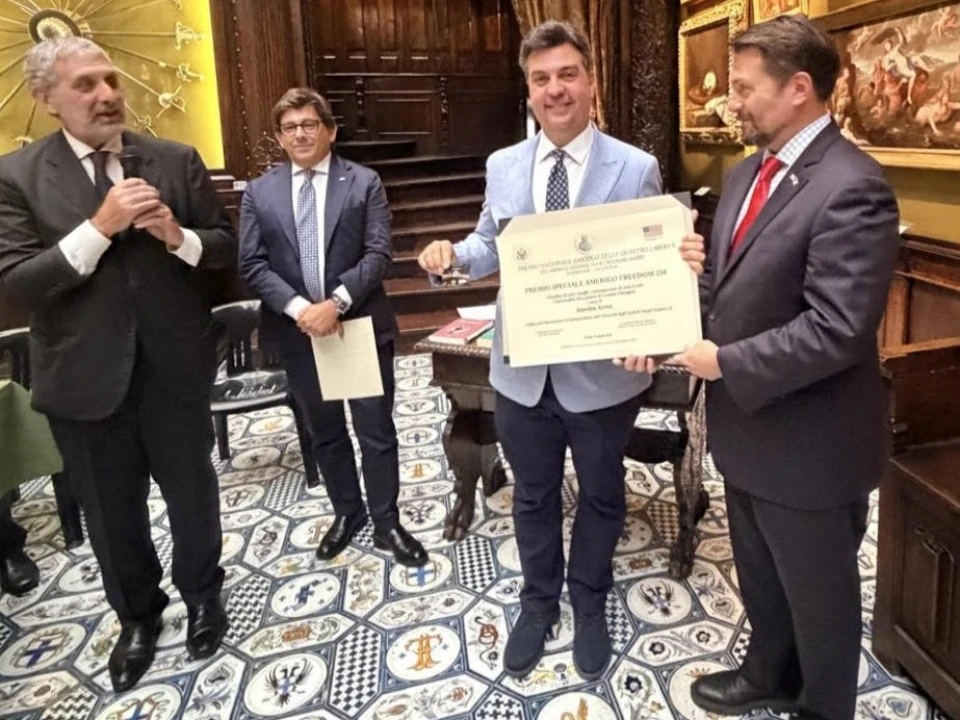
This year's ceremony carried a particularly significant transatlantic dimension: as part of the celebrations for the 250th anniversary of the Declaration of Independence, the Consulate General of the United States in Naples conferred a special award on Professor Amedeo Arena for his edited volume "Cittadino di tutti i luoghi, contemporaneo di tutte l'età: l'universalità del pensiero di Gaetano Filangieri.”
The award recognised Professor Arena’s long-standing research on Filangieri, Benjamin Franklin, and the intellectual ties between Naples and Philadelphia in the age of the American Revolution. His work draws on archival materials preserved at the Museo Filangieri and he has given several talks in Italy and the United States devoted to the Filangieri’s intellectual legacy.
In his remarks, Consul General Flynn underlined the importance of celebrating this transatlantic connection in the museum dedicated to Filangieri. "It is an honour for me” he stated “to present this award and to celebrate not only the 250 years of the United States, but also the historic relations between Naples and the United States, between Benjamin Franklin and Gaetano Filangieri, precisely in this Museum dedicated to him."
Edoardo Imperiale, President of the Amerigo Association, which brings together Italian alumni of exchange programmes promoted by the United States Department of State, stressed that the eleventh edition of the Amerigo Award confirmed how “the values of freedom, dialogue, human dignity, and peace are more relevant than ever today.” “In a world marked by deep transformations and geopolitical tensions”, he added, “culture remains one of the most effective instruments for building mutual understanding, respect, and cooperation among peoples.”
The award-winning volume collects sixteen essays exploring the relevance of Filangieri’s thought across different historical and geographical contexts, from the eighteenth century to the present day. Its epilogue is devoted to the Filangieri-Franklin correspondence and includes transcriptions of letters preserved at the Museo Filangieri, the American Philosophical Society, and the Historical Society of Pennsylvania. The volume, published by Editoriale Scientifica in Naples and currently being translated into English, is freely available on the publisher’s website: https://editorialescientifica.it/prodotto/cittadino-di-tutti-i-luogh
The “Filangieri-Franklin correspondence”, as Professor Arena put it, “was not merely an exchange of letters and documents, but a deeper correspondence of convictions and ideals," one that still makes possible a fruitful dialogue between Italy and the United States. He accepted the award “as a recognition of the importance of dialogue among peoples as a foundation for mutual understanding, peace, and cooperation”, adding: "The Filangieri-Franklin correspondence is part of our shared heritage. Let us keep that conversation going through academic and cultural exchanges."
In his concluding remarks, Professor Arena recalled the Filangieri Prize, awarded annually by the Accademia Filangieri di Partenope under the patronage of the Museo Civico Gaetano Filangieri to young law graduates whose dissertations engage with the philosopher's ideals. To them he quoted a passage from Filangieri’s treatise “La scienza della legislazione": “Never write for one man, but for mankind; unite your glory with the eternal interests of the human race; instruct your brethren with courage, and speak freely in defence of their rights; and then men, moved by the pursuit of happiness and by the path towards it that you show them, will listen to you with fervour; and your ever-useful genius will then be a contemporary of all ages, and a citizen of all places.”